
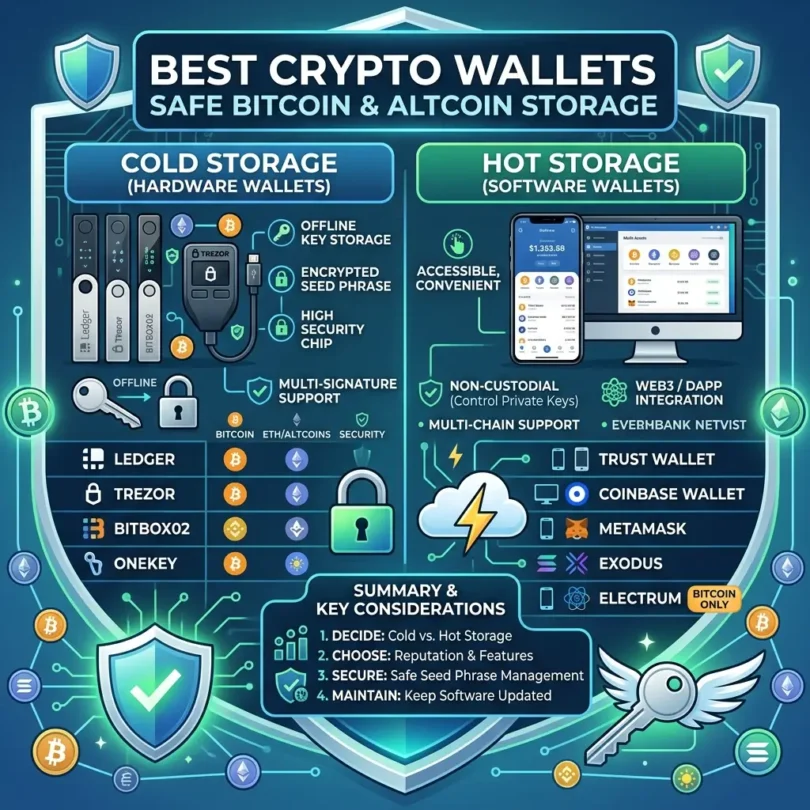

Choosing the best crypto wallet is one of the most important steps for anyone holding Bitcoin, Ethereum, stablecoins, altcoins, NFTs, or DeFi assets.
A crypto exchange is useful for buying and trading, but a crypto wallet is what gives users more control over digital assets. The right wallet can help protect private keys, manage multiple blockchains, store NFTs, connect to Web3 apps, and keep long-term holdings away from exchange custody risk.
But wallets also come with responsibility.
If you use a self-custody wallet, you control the private keys. That means you are responsible for protecting your recovery phrase, avoiding phishing scams, confirming addresses carefully, and keeping your device safe. Coinbase Wallet explains that it is a self-custody Web3 wallet that puts users in full control of the private keys to assets on the blockchain, and that nobody, including Coinbase, can access tokens or NFTs without the recovery phrase. (Coinbase)
This guide compares the best crypto wallets for safe Bitcoin and altcoin storage, explains hot wallets vs cold wallets, shows what security features matter, and helps beginners choose the right wallet based on their needs.
Important Disclaimer
This article is for general informational purposes only. It is not legal, tax, investment, accounting, cybersecurity, or professional advice.
Cryptocurrency involves risk. Wallet mistakes can cause permanent loss. Prices can change quickly, blockchain transactions are usually irreversible, and self-custody requires careful security habits. Always research carefully and consult qualified professionals before making important decisions about crypto storage, taxes, wallets, custody, or security.
What Is a Crypto Wallet?
A crypto wallet is a tool that lets users store, send, receive, and manage digital assets.
A wallet does not technically “hold” coins inside the app like cash in a pocket. Digital assets exist on blockchains. A wallet stores or manages the private keys that allow users to control those assets.
A crypto wallet may help users:
- Receive Bitcoin
- Send Ethereum
- Store altcoins
- Manage NFTs
- Connect to DeFi apps
- Sign blockchain transactions
- Track balances
- Use Web3 apps
- Swap tokens
- Stake assets, depending on wallet
- Store stablecoins
- Manage multiple networks
- Use hardware wallet protection
The wallet is your access point to blockchain assets. If someone gets your private key or recovery phrase, they can control your assets.
Crypto Wallet Basics: Private Keys, Public Addresses and Recovery Phrases
Before choosing a wallet, understand these three terms.
Public Address
A public address is like a receiving address.
You can share it with someone who wants to send you crypto.
Example:
- Bitcoin receiving address
- Ethereum address
- Solana address
- Polygon address
A public address does not give someone control of your wallet. But it can reveal transaction history on public blockchains.
Private Key
A private key is what gives control over assets connected to a wallet address.
Never share private keys.
If someone has your private key, they can move your funds.
Secret Recovery Phrase
A secret recovery phrase, also called a seed phrase or wallet backup, is usually a group of 12, 18, or 24 words that can restore your wallet.
MetaMask explains that a Secret Recovery Phrase is generated when a user first sets up MetaMask and is used to restore wallet access. (MetaMask Help Center) MetaMask also warns users not to share their Secret Recovery Phrase or private keys because anyone with them can control the assets and send tokens out of the wallet. (MetaMask Help Center)
This is the most important wallet safety rule:
Never share your recovery phrase with anyone.
No real wallet company, exchange, support agent, admin, influencer, giveaway page, or government agency should ask for your seed phrase.
Hot Wallet vs Cold Wallet
Crypto wallets are often divided into two main categories: hot wallets and cold wallets.
Hot Wallet
A hot wallet is connected to the internet.
Examples include:
- Mobile wallet apps
- Browser extension wallets
- Desktop wallets
- Web3 wallets
- Exchange wallets
Hot wallets are convenient for frequent transactions, DeFi, NFTs, swaps, and daily use.
Pros
- Easy to use
- Fast transactions
- Good for DeFi and NFTs
- Mobile access
- Browser extension support
- Free to start
- Good for smaller amounts
- Useful for beginners
Cons
- More exposed to malware
- More phishing risk
- Browser extension risk
- Device compromise risk
- Scam website risk
- Not ideal for large long-term holdings
Cold Wallet
A cold wallet keeps private keys offline.
The most common cold wallet is a hardware wallet.
Examples include:
- Ledger
- Trezor
- Coldcard
- BitBox
- Keystone
- SafePal hardware wallet
Ledger explains that hardware wallets store private keys offline, giving users full control and enhanced security, and that users can recover assets using the Secret Recovery Phrase if the device is lost. (Ledger)
Pros
- Private keys stay offline
- Better for long-term storage
- Lower online attack exposure
- Good for large holdings
- Transaction confirmation on device
- Stronger protection against malware
- Can be used with wallet apps
Cons
- Costs money
- Requires careful setup
- Recovery phrase must be protected
- Device can be lost or damaged
- Beginners may find it confusing
- Fake-device scams exist
For serious long-term storage, a hardware wallet is usually safer than a hot wallet.
Custodial Wallet vs Self-Custody Wallet
Another important difference is custodial vs self-custody.
Custodial Wallet
A custodial wallet means a third party controls the private keys.
Examples:
- Exchange account wallet
- Some crypto apps
- Broker-style platforms
Pros
- Easier for beginners
- Password reset may be possible
- Customer support available
- Simple buying and selling
- No seed phrase management
Cons
- You do not control private keys
- Platform can freeze withdrawals
- Platform failure risk
- Account lock risk
- KYC required
- Not ideal for long-term large holdings
Self-Custody Wallet
A self-custody wallet means you control the private keys.
Examples:
- MetaMask
- Trust Wallet
- Coinbase Wallet
- Exodus
- Ledger
- Trezor
- Phantom
- Rabby
Pros
- You control assets directly
- No exchange withdrawal approval
- Better Web3 access
- Can connect to DeFi
- Can store NFTs
- Can use hardware wallets
Cons
- No password reset if seed phrase is lost
- You are responsible for security
- Phishing risk
- Wrong transaction risk
- Scam token risk
- Requires learning
Coinbase Wallet describes itself as a self-custody wallet that puts users in control of crypto, keys, and data. (Coinbase)
Best Crypto Wallets for Safe Bitcoin and Altcoin Storage
Below are the best crypto wallets to compare. The right wallet depends on whether you want beginner simplicity, mobile access, DeFi use, NFT support, hardware security, Bitcoin-only storage, or multi-chain altcoin support.
1. Ledger
Best for: Hardware wallet security and long-term multi-asset storage
Good for: Bitcoin holders, Ethereum users, altcoin investors, NFT users
Main strength: Offline private key storage with broad asset support
Ledger is one of the most popular hardware wallet brands. It offers devices such as Ledger Nano S Plus, Ledger Nano X, and Ledger Stax, depending on availability and region.
Ledger says hardware wallets store private keys offline and allow users to recover assets with the Secret Recovery Phrase if the device is lost. (Ledger)
Key Features
- Hardware wallet storage
- Offline private key protection
- Ledger Live app
- Bitcoin support
- Ethereum support
- Many altcoins
- NFT support
- Staking support for some assets
- Bluetooth on selected models
- USB-C connectivity on selected models
- Recovery phrase backup
- PIN protection
- Transaction confirmation on device
Why Ledger Is Good
Ledger is a strong option for users who want to store crypto for the long term. Because the private keys stay offline, Ledger provides better protection than a browser extension wallet on an internet-connected computer.
Ledger also supports many assets, which makes it useful for people holding more than only Bitcoin.
Best Fit
Ledger may fit:
- Long-term holders
- Multi-asset investors
- NFT holders
- Users with larger balances
- People who want hardware-level protection
- Users who want Ledger Live portfolio access
- People who want cold storage with broad coin support
Possible Downsides
Ledger is not free. Users must buy the device from official sources only. Fake hardware wallet scams can be dangerous. A recent report described a counterfeit Ledger Nano S Plus that was designed to collect sensitive data through malicious software from a fake Ledger website. (Tom’s Hardware)
Always buy hardware wallets from the official website or trusted official resellers.
2. Trezor
Best for: Open-source hardware wallet users and long-term storage
Good for: Bitcoin holders, Ethereum users, security-focused beginners
Main strength: Hardware security and open-source reputation
Trezor is another leading hardware wallet brand. It offers hardware wallets focused on secure private key storage and transaction confirmation.
Trezor explains that a hardware wallet enables safe transactions while protecting the private key, and Trezor devices use a wallet backup, also called a recovery phrase, to restore access if needed. (Trezor)
Key Features
- Hardware wallet storage
- Offline private key protection
- Trezor Suite app
- Bitcoin support
- Ethereum support
- Many altcoins
- PIN protection
- Recovery phrase backup
- Passphrase support
- Open-source ecosystem
- Transaction confirmation on device
- Desktop and browser support
Why Trezor Is Good
Trezor is a strong choice for people who want hardware wallet protection and value open-source wallet tools. It is often compared directly with Ledger.
Trezor is especially popular among users who want a simple hardware wallet experience without relying only on mobile wallet storage.
Best Fit
Trezor may fit:
- Long-term Bitcoin holders
- Ethereum users
- Security-focused beginners
- Users who prefer open-source tools
- People who want hardware wallet protection
- Users who want passphrase support
Possible Downsides
Trezor asset support may differ from Ledger depending on the asset. Users should check supported coins before buying. Like all hardware wallets, the recovery phrase must be protected carefully.
3. MetaMask
Best for: Ethereum, DeFi, NFTs and Web3 apps
Good for: Ethereum users, DeFi users, NFT collectors, browser extension users
Main strength: Web3 connectivity and broad Ethereum ecosystem support
MetaMask is one of the most widely used crypto wallets for Ethereum and EVM-compatible networks.
MetaMask’s website says users can set up a crypto wallet, buy and sell BTC, ETH, SOL and more, and have control over their data and assets. It also highlights security alerts, frontrun protection, Wallet Guard built in, and real-time threat monitoring. (MetaMask)
Key Features
- Browser extension
- Mobile app
- Ethereum support
- EVM network support
- DeFi access
- NFT access
- Token swaps
- WalletConnect-style connections
- Hardware wallet connection support
- Security alerts
- Custom networks
- Dapp connections
- Secret Recovery Phrase backup
Why MetaMask Is Good
MetaMask is one of the best hot wallets for Web3 activity. If you use Ethereum, Polygon, Arbitrum, Optimism, Base, BNB Chain, Avalanche, or other EVM networks, MetaMask is widely supported by DeFi apps and NFT marketplaces.
It is especially useful for people who actively interact with decentralized apps.
Best Fit
MetaMask may fit:
- Ethereum users
- DeFi users
- NFT collectors
- Web3 app users
- People using Layer-2 networks
- Users who need browser extension access
- Advanced users who manage multiple networks
Possible Downsides
MetaMask is a hot wallet, so it is more exposed than a hardware wallet. Users must avoid phishing links, fake airdrops, malicious token approvals, fake support messages, and unsafe browser extensions.
MetaMask warns that anyone with your Secret Recovery Phrase or private keys can control your assets. (MetaMask Help Center)
For larger balances, use MetaMask with a hardware wallet.
4. Coinbase Wallet
Best for: Beginner-friendly self-custody and Coinbase ecosystem users
Good for: Web3 beginners, NFT users, mobile users, Coinbase users
Main strength: Simple self-custody wallet with familiar brand
Coinbase Wallet is different from keeping crypto on the Coinbase exchange. Coinbase Wallet is a self-custody wallet.
Coinbase says Coinbase Wallet is a self-custody Web3 wallet that gives users full control of private keys, and nobody, including Coinbase, can access tokens or NFTs without the recovery phrase. (Coinbase)
Key Features
- Self-custody wallet
- Mobile app
- Browser extension
- NFT support
- Web3 app access
- Multiple networks
- Crypto swaps
- Recovery phrase backup
- Coinbase ecosystem familiarity
- Security education
- User-friendly design
Why Coinbase Wallet Is Good
Coinbase Wallet is a good bridge between beginner crypto users and Web3 self-custody. It is easier to understand than some advanced wallets, while still giving users control over private keys.
It can be useful for users who already trust Coinbase as a brand but want a self-custody wallet rather than keeping everything on the exchange.
Best Fit
Coinbase Wallet may fit:
- Beginners learning self-custody
- Coinbase users
- NFT collectors
- Mobile-first users
- Web3 beginners
- People who want a familiar interface
- Users who want private key control
Possible Downsides
Self-custody means the user is responsible for the recovery phrase. If the phrase is lost, access may be lost. If the phrase is stolen, assets can be stolen.
5. Trust Wallet
Best for: Mobile multi-chain crypto storage
Good for: Mobile users, altcoin holders, multi-chain users
Main strength: Broad asset and network support on mobile
Trust Wallet is a popular mobile crypto wallet that supports many chains and assets.
It is often used by people who want one mobile wallet for Bitcoin, Ethereum, BNB Chain, Solana, Polygon, and many other assets.
Key Features
- Mobile wallet
- Multi-chain support
- NFT support
- Token swaps
- Dapp browser, depending on device and region
- Staking for some assets
- Self-custody
- Recovery phrase backup
- Broad altcoin support
- Simple mobile interface
Why Trust Wallet Is Good
Trust Wallet is convenient for users who want broad asset support in one mobile app. It is especially useful for people holding many altcoins across different chains.
Best Fit
Trust Wallet may fit:
- Mobile users
- Altcoin holders
- Multi-chain users
- BNB Chain users
- NFT users
- People who want simple self-custody
Possible Downsides
Mobile wallets can be risky if the phone is compromised, lost, infected, or backed up insecurely. Users should protect the phone with strong security and never store the recovery phrase in screenshots, cloud notes, or messages.
6. Exodus
Best for: Beginner-friendly desktop and mobile wallet experience
Good for: Beginners, multi-asset holders, users who want a clean interface
Main strength: Easy design and broad asset management
Exodus is a popular software wallet known for its clean design and user-friendly dashboard.
It supports many assets and is available on desktop and mobile. It can also connect with Trezor hardware wallets, depending on setup.
Key Features
- Desktop wallet
- Mobile wallet
- Multi-asset support
- Portfolio dashboard
- Built-in swaps
- NFT support for some networks
- Trezor integration
- Simple design
- Self-custody
- Recovery phrase backup
Why Exodus Is Good
Exodus is one of the easiest wallets for beginners who want to store multiple assets without using a browser extension. The interface is visually simple and beginner-friendly.
Best Fit
Exodus may fit:
- Beginners
- Desktop users
- Multi-asset holders
- Users who want a clean interface
- People who want Trezor integration
- Users who do not need heavy DeFi interaction
Possible Downsides
As a software wallet, Exodus is still a hot wallet. It is safer than leaving assets carelessly on unknown platforms, but it is not as secure as a hardware wallet for large long-term storage.
7. Phantom
Best for: Solana ecosystem and multi-chain Web3 users
Good for: Solana users, NFT users, DeFi users, mobile and browser users
Main strength: Solana-native wallet experience with expanding multi-chain support
Phantom became popular as a Solana wallet and has expanded to support more networks.
It is widely used by Solana NFT collectors, DeFi users, and token holders.
Key Features
- Solana support
- NFT support
- Browser extension
- Mobile app
- Token swaps
- DeFi app connections
- Multi-chain support
- Transaction previews
- Scam detection features
- Hardware wallet support in some setups
- Self-custody
Why Phantom Is Good
Phantom is one of the best wallets for Solana users. It offers a clean interface, fast transactions, NFT display, and Web3 connectivity.
Best Fit
Phantom may fit:
- Solana users
- NFT collectors
- DeFi users
- Mobile users
- Browser extension users
- Multi-chain Web3 users
Possible Downsides
Phantom is still a hot wallet. Users must be careful with fake NFT airdrops, scam links, malicious dapps, and token approval traps.
8. Rabby Wallet
Best for: EVM DeFi users who want transaction previews
Good for: Advanced Ethereum users, DeFi users, Layer-2 users
Main strength: DeFi-focused safety features and transaction simulation
Rabby Wallet is popular among DeFi users because it provides transaction previews and a more DeFi-focused interface than many basic wallets.
Key Features
- Browser extension
- Ethereum support
- EVM network support
- DeFi transaction previews
- Transaction simulation
- Risk warnings
- Multi-chain EVM support
- Hardware wallet connection
- Token approval management
- Self-custody
Why Rabby Is Good
Rabby is useful for advanced users who interact with DeFi protocols and want more information before signing transactions. Its transaction simulation and risk warning features can help reduce some Web3 mistakes.
Best Fit
Rabby may fit:
- DeFi users
- Ethereum users
- Layer-2 users
- Advanced traders
- Users who sign many transactions
- Hardware wallet users who want a better front-end
Possible Downsides
Rabby is more advanced than beginner wallets. New users may need time to understand transaction previews and DeFi risk warnings.
9. Electrum
Best for: Bitcoin-only users
Good for: Advanced Bitcoin users, desktop users, hardware wallet users
Main strength: Lightweight Bitcoin wallet with long history
Electrum is a long-running Bitcoin wallet. It is focused on Bitcoin rather than altcoins.
Key Features
- Bitcoin-only wallet
- Desktop wallet
- Lightweight setup
- Hardware wallet support
- Advanced coin control
- Custom fees
- Multi-signature support
- Open-source software
- Recovery phrase backup
- Advanced Bitcoin tools
Why Electrum Is Good
Electrum is a strong option for Bitcoin users who want more control than a simple mobile wallet provides. It is especially useful for people who understand Bitcoin transactions, fees, and hardware wallet workflows.
Best Fit
Electrum may fit:
- Bitcoin-only users
- Advanced Bitcoin holders
- Hardware wallet users
- Multi-signature users
- Desktop users
- People who want coin control
Possible Downsides
Electrum is not designed for beginners who want a polished mobile-first experience. It does not support altcoins. Users must download only from the official website because fake wallet downloads are a major risk.
10. Safe
Best for: Multi-signature wallet security
Good for: Teams, DAOs, businesses, shared treasury users, advanced holders
Main strength: Multi-signature asset control
Safe, previously known as Gnosis Safe, is a multi-signature smart contract wallet used by teams, DAOs, businesses, and advanced users.
Multi-signature means more than one approval is required to move assets.
Key Features
- Multi-signature wallet
- Team wallet management
- Smart contract wallet
- Ethereum and EVM support
- Role-based signing
- Treasury management
- Dapp integrations
- Hardware wallet support
- Transaction batching
- Shared control
Why Safe Is Good
Safe is useful when one person should not control all assets alone. For example, a company or DAO may require 2-of-3 or 3-of-5 approvals before a transaction can happen.
This reduces single-key risk.
Best Fit
Safe may fit:
- Businesses using crypto
- DAO treasuries
- Teams
- Shared wallets
- Family offices
- Advanced users
- Large holders wanting multi-sig security
Possible Downsides
Safe is more complex than a normal wallet. It is best for advanced users or teams that understand multi-signature setup, signer management, and smart contract wallet risks.
Quick Comparison Table
| Wallet | Best For | Wallet Type | Main Strength |
|---|---|---|---|
| Ledger | Long-term multi-asset storage | Hardware wallet | Offline private keys |
| Trezor | Open-source hardware storage | Hardware wallet | Secure backup and device signing |
| MetaMask | Ethereum and DeFi | Hot wallet | Web3 app support |
| Coinbase Wallet | Beginner self-custody | Hot wallet | Simple self-custody experience |
| Trust Wallet | Mobile multi-chain users | Hot wallet | Broad asset support |
| Exodus | Beginner desktop/mobile users | Hot wallet | Clean interface |
| Phantom | Solana users | Hot wallet | Solana NFTs and DeFi |
| Rabby | Advanced EVM DeFi | Hot wallet | Transaction previews |
| Electrum | Bitcoin-only users | Hot wallet/software wallet | Advanced Bitcoin control |
| Safe | Teams and businesses | Smart contract wallet | Multi-signature approvals |
Best Crypto Wallet by User Type
Best for Beginners
Best options:
- Coinbase Wallet
- Trust Wallet
- Exodus
- MetaMask
Beginners should focus on ease of use, clear backup instructions, simple sending and receiving, and strong scam warnings.
Best for Long-Term Holders
Best options:
- Ledger
- Trezor
- Coldcard, for Bitcoin-only advanced users
- BitBox, for security-focused users
Long-term holders should prioritize cold storage and recovery phrase protection.
Best for Bitcoin Storage
Best options:
- Trezor
- Ledger
- Electrum
- Coldcard
- Sparrow Wallet with hardware wallet
Bitcoin-only users may prefer wallets that focus strongly on Bitcoin security and transaction control.
Best for Ethereum and DeFi
Best options:
- MetaMask
- Rabby
- Ledger with MetaMask
- Trezor with MetaMask
- Coinbase Wallet
DeFi users should consider using a hardware wallet connected to a Web3 wallet.
Best for Solana
Best options:
- Phantom
- Ledger with Solana support
- Solflare
Phantom is one of the most popular options for Solana NFTs and DeFi.
Best for NFTs
Best options:
- MetaMask
- Phantom
- Coinbase Wallet
- Ledger
- Trezor, depending on NFT chain support
NFT users should be especially careful with fake mint sites and scam airdrops.
Best for Businesses and Teams
Best options:
- Safe
- Ledger Enterprise-style tools
- Coinbase Prime-style custody options
- Fireblocks-style custody platforms
Teams should avoid single-person wallet control for large holdings.
Seed Phrase Safety: The Most Important Wallet Rule
Your recovery phrase is the master key.
If you lose it, you may lose access.
If someone steals it, they can steal your assets.
Follow these rules:
- Write it down offline
- Never store it in cloud notes
- Never take screenshots
- Never send it in email
- Never text it to yourself
- Never enter it into a random website
- Never share it with support
- Keep backups in secure locations
- Consider metal backup for fire and water resistance
- Test recovery with small amounts before storing large balances
- Use passphrase features only if you understand them
A real wallet support team should never ask for your recovery phrase.
A South Korean government-related incident reported by Tom’s Hardware showed how dangerous seed phrase exposure can be: authorities reportedly lost over $4.8 million in crypto after a mnemonic recovery phrase was accidentally posted online. (Tom’s Hardware)
That one mistake can be enough to lose everything.
Hardware Wallet Buying Safety
Hardware wallets are excellent, but only if purchased safely.
Follow these rules:
- Buy from official website
- Avoid random marketplaces
- Avoid used devices
- Check packaging carefully
- Initialize the device yourself
- Do not use a pre-written seed phrase
- Never scan QR codes from suspicious packaging
- Confirm device authenticity with official software
- Update firmware only through official apps
- Bookmark official wallet websites
Fake hardware wallet scams are real. A recent report described a fake Ledger device that looked convincing and directed users toward malicious software designed to steal seed and PIN data. (Tom’s Hardware)
Hot Wallet Safety Tips
If you use MetaMask, Trust Wallet, Coinbase Wallet, Phantom, Rabby, or another hot wallet, follow these safety rules:
- Use a dedicated browser profile
- Avoid suspicious browser extensions
- Bookmark real dapp websites
- Never click random airdrop links
- Do not sign unknown messages
- Review transaction details before signing
- Use token approval tools
- Revoke old permissions
- Keep device updated
- Use antivirus and malware protection
- Avoid public Wi-Fi for wallet activity
- Do not store seed phrase digitally
- Use hardware wallet for larger balances
Hot wallets are convenient, but convenience creates exposure.
Common Crypto Wallet Mistakes
Mistake 1: Storing the Seed Phrase Online
Cloud notes, email drafts, screenshots, and messaging apps are dangerous places for recovery phrases.
Mistake 2: Buying a Hardware Wallet From an Unknown Seller
Fake or tampered devices can steal funds.
Mistake 3: Keeping Large Balances in a Browser Wallet
Browser wallets are useful, but not ideal for large long-term storage.
Mistake 4: Signing Unknown Transactions
A malicious transaction can approve token spending or transfer assets.
Mistake 5: Sending Crypto on the Wrong Network
A token sent on the wrong chain may be difficult or impossible to recover.
Mistake 6: Ignoring Test Transactions
Send a small test amount before moving large balances.
Mistake 7: Forgetting Wallet Password vs Seed Phrase Difference
A wallet password unlocks the app on that device. The seed phrase restores the wallet anywhere.
Mistake 8: Trusting Fake Support
Scammers pretend to be wallet support. Real support should not ask for private keys or seed phrases.
Mistake 9: Not Updating Wallet Software
Old wallet versions may miss important security updates.
Mistake 10: Not Planning Inheritance
If something happens to you, trusted heirs may not know how to access assets. Plan carefully with qualified professionals.
How to Choose the Best Crypto Wallet
Use this checklist.
1. Decide Your Main Use
Ask:
- Am I buying and holding?
- Am I trading often?
- Am I using DeFi?
- Am I collecting NFTs?
- Am I holding Bitcoin only?
- Am I managing assets for a team?
- Am I storing a large amount?
Different use cases need different wallets.
2. Choose Hot or Cold Storage
Use hot wallet for:
- Small balances
- DeFi
- NFTs
- Daily transactions
- Testing Web3 apps
Use cold wallet for:
- Long-term holdings
- Larger balances
- Bitcoin savings
- Important NFTs
- Assets you do not trade often
3. Check Asset Support
Make sure the wallet supports your coins and chains.
4. Check Security Features
Look for:
- Recovery phrase backup
- PIN
- Biometrics
- Hardware wallet support
- Transaction preview
- Address book
- Security alerts
- Multi-signature support
- Passphrase support
5. Check Reputation
Use wallets with strong community reputation, official websites, and clear security history.
6. Test With Small Amounts
Before sending large amounts, test with small transactions.
7. Keep Records
Save transaction records for tax and personal tracking.
Best Wallet Setup for Most Users
A smart setup may look like this:
Beginner Setup
- Coinbase or Kraken for buying
- Coinbase Wallet or Trust Wallet for small self-custody
- Hardware wallet later for long-term storage
Intermediate Setup
- Exchange for buying
- Hardware wallet for long-term holdings
- MetaMask or Rabby connected to hardware wallet for DeFi
- Separate hot wallet for testing new apps
Advanced Setup
- Hardware wallet for main holdings
- Separate wallets for DeFi, NFTs, testing, and airdrops
- Multi-signature Safe for large team or business holdings
- Metal recovery phrase backup
- Strict transaction review process
Never keep all assets in one risky wallet.
Final Verdict: What Are the Best Crypto Wallets?
The best crypto wallet depends on your goal.
For most users:
- Best hardware wallet for multi-asset storage: Ledger
- Best open-source hardware wallet: Trezor
- Best Ethereum and DeFi wallet: MetaMask
- Best beginner self-custody wallet: Coinbase Wallet
- Best mobile multi-chain wallet: Trust Wallet
- Best beginner desktop/mobile wallet: Exodus
- Best Solana wallet: Phantom
- Best DeFi transaction preview wallet: Rabby
- Best Bitcoin-only software wallet: Electrum
- Best multi-signature wallet for teams: Safe
If you are holding a meaningful amount of crypto, consider using a hardware wallet. If you are active in DeFi or NFTs, use a hot wallet for daily activity but avoid keeping your full balance there. If you manage assets with a team, use multi-signature controls instead of trusting one person’s private key.
The best wallet is not only the one with the most features. It is the one you can use safely, understand clearly, and protect consistently.
FAQs About Crypto Wallets
What is the best crypto wallet?
The best crypto wallet depends on your needs. Ledger and Trezor are strong for cold storage. MetaMask is strong for Ethereum and DeFi. Coinbase Wallet is good for beginner self-custody. Trust Wallet is good for mobile multi-chain storage. Phantom is strong for Solana.
What is the safest crypto wallet?
A properly set up hardware wallet such as Ledger or Trezor is usually safer for long-term storage because private keys stay offline. Ledger says hardware wallets store private keys offline and can be restored using the Secret Recovery Phrase if the device is lost. (Ledger)
Is Coinbase Wallet the same as Coinbase exchange?
No. Coinbase Wallet is a self-custody wallet. Coinbase says nobody, including Coinbase, can access your tokens or NFTs without your recovery phrase. (Coinbase)
Is MetaMask safe?
MetaMask can be safe when used carefully, but it is a hot wallet. Users must protect their Secret Recovery Phrase, avoid phishing links, and review transactions before signing. MetaMask warns that anyone with your recovery phrase or private keys can control your assets. (MetaMask Help Center)
What is a seed phrase?
A seed phrase, also called a recovery phrase, is a group of words that can restore wallet access. It must be kept private and offline.
What happens if I lose my seed phrase?
If you lose your seed phrase and lose access to your wallet device or app, you may permanently lose access to your crypto.
Can wallet support recover my crypto?
Usually no. In self-custody wallets, support teams cannot recover assets without your recovery phrase, and you should never share that phrase with anyone.
Should I use a hardware wallet?
If you hold a meaningful amount of crypto or plan to store assets long term, a hardware wallet is strongly worth considering.
Can I use MetaMask with Ledger or Trezor?
Yes, many users connect hardware wallets to MetaMask. This allows Web3 access while keeping private keys protected by the hardware wallet.
What is a hot wallet?
A hot wallet is connected to the internet. Examples include MetaMask, Trust Wallet, Coinbase Wallet, Phantom, and Exodus.
What is a cold wallet?
A cold wallet keeps private keys offline. Hardware wallets such as Ledger and Trezor are common cold wallet options.
Can a fake hardware wallet steal crypto?
Yes. Fake hardware wallets can be designed to steal recovery phrases or private data. A recent report described a counterfeit Ledger device that attempted to trick users into downloading malicious software. (Tom’s Hardware)
Should I store my seed phrase in Google Drive or iCloud?
No. Do not store your seed phrase in cloud storage, screenshots, emails, notes apps, or messaging apps. Keep it offline.