
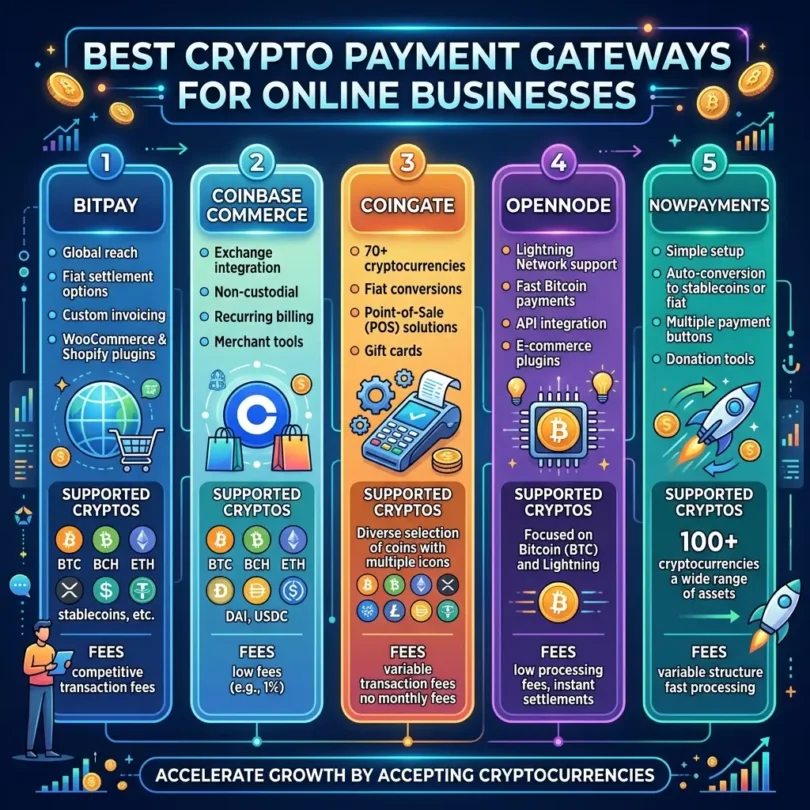

Crypto payment gateways help online businesses accept Bitcoin, Ethereum, stablecoins, and other digital assets from customers.
For many merchants, the biggest benefit is not speculation. It is payment flexibility.
A crypto payment gateway can allow customers to pay with crypto while the business receives local currency or stablecoins, depending on the provider. Some gateways also support invoices, checkout buttons, payment links, API integration, WooCommerce plugins, Shopify-style checkout flows, donation pages, subscriptions, payouts, and settlement reports.
This matters for online businesses serving global customers.
A buyer in one country may not have an international card. A customer may prefer USDT or USDC. A software company may want fast cross-border payment collection. A digital product seller may want fewer card chargebacks. A Web3 business may need crypto-native checkout. A marketplace may want stablecoin settlement. A service provider may want invoice links for international clients.
But crypto payments also create new responsibilities.
Businesses must think about volatility, tax records, refund handling, local rules, customer support, transaction confirmations, wallet security, fraud controls, accounting records, and provider reliability.
BitPay says crypto payment processor fees are typically less than half of credit card processing costs, blockchain payments are irreversible, and merchants can receive crypto payments while settling in fiat to avoid market volatility exposure. (BitPay) CoinGate says businesses can accept BTC, USDC and other assets globally, convert to fiat or stablecoins, and settle into EUR, USD, or stablecoins. (Best Bitcoin & Crypto Payment Processor) Triple-A says it offers digital currency payments for businesses with instant settlement and zero volatility, including USDT and USDC support. (Triple A)
This guide compares the best crypto payment gateways for online businesses, explains what features matter, and helps merchants choose the right provider based on checkout setup, supported assets, settlement needs, compliance requirements, plugins, fees, and security.
Important Disclaimer
This article is for general informational purposes only. It is not legal, tax, accounting, investment, cybersecurity, payment-processing, or professional advice.
Crypto payment rules, tax treatment, reporting duties, merchant policies, customer verification requirements, settlement options, fees, supported countries, and supported assets can change. Always review provider terms, local laws, tax rules, and official contracts before accepting crypto payments. Speak with a qualified attorney, accountant, tax professional, payment consultant, or compliance expert when needed.
What Is a Crypto Payment Gateway?
A crypto payment gateway is a service that helps businesses accept cryptocurrency payments from customers.
Instead of asking a customer to manually send crypto to a wallet address, a payment gateway can create a checkout page or invoice that shows the amount, crypto address, QR code, payment timer, exchange rate, and confirmation status.
A crypto payment gateway may help with:
- Bitcoin payments
- Ethereum payments
- USDT payments
- USDC payments
- Litecoin payments
- Solana payments, depending on provider
- Stablecoin settlement
- Fiat settlement
- Payment links
- Checkout buttons
- Hosted checkout pages
- API integration
- WooCommerce plugins
- Shopify-style integrations, where available
- WHMCS plugins
- Magento plugins
- Invoice creation
- Donation buttons
- Subscription billing, depending on provider
- Merchant dashboards
- Refund tools
- Transaction history
- Settlement reports
- Payouts
- Customer payment tracking
- Currency conversion
The gateway sits between the customer and the merchant. It helps make crypto payments easier to accept in a normal online business flow.
How Crypto Payment Gateways Work
A typical crypto checkout process looks like this:
- Customer chooses crypto at checkout.
- Gateway creates a payment invoice.
- Customer selects coin or stablecoin.
- Gateway shows a wallet address or QR code.
- Customer sends crypto.
- Blockchain confirms transaction.
- Gateway marks invoice as paid.
- Merchant receives crypto, stablecoin, or local currency, depending on settings.
- Merchant downloads reports for bookkeeping and tax records.
Some gateways convert crypto to local currency immediately. Others send crypto directly to the merchant wallet. Some let the merchant choose stablecoin settlement.
CoinGate explains that managed gateways can let customers pay in crypto while the gateway converts payment to chosen fiat currency at the locked exchange rate and settles to a bank account, helping merchants avoid crypto volatility risk. (Best Bitcoin & Crypto Payment Processor)
Why Online Businesses Use Crypto Payment Gateways
1. Global Customer Reach
Crypto payments can help businesses accept customers from countries where card payments, bank transfers, or cross-border checkout options may be limited.
2. Stablecoin Payments
Stablecoins such as USDT and USDC are widely used for digital payments. Some businesses prefer stablecoins because they reduce exposure to Bitcoin or altcoin volatility.
3. Lower Chargeback Risk
Blockchain payments are generally irreversible. BitPay highlights that blockchain payments are irreversible as part of its merchant value proposition. (BitPay)
This does not remove refund responsibility, but it reduces classic card-style chargeback exposure.
4. Faster Cross-Border Settlement
Crypto and stablecoin payments may settle faster than some traditional cross-border methods, depending on network, provider, and compliance checks.
5. Digital Product Sales
Crypto payments can be useful for:
- SaaS tools
- Digital downloads
- Online courses
- VPN services
- Hosting companies
- Web3 apps
- Gaming platforms
- Marketplaces
- Freelance services
- Donation pages
6. Customer Preference
Some customers prefer paying with crypto because they already hold digital assets.
7. Business Differentiation
Accepting crypto can make a tech-focused brand look more modern, especially if the audience is global or Web3-aware.
Best Crypto Payment Gateways for Online Businesses
Below are the best crypto payment gateways to compare. The right option depends on your country, website platform, settlement preference, customer base, crypto assets needed, compliance requirements, and technical team.
1. BitPay
Best for: Established businesses wanting a mature crypto payment processor
Good for: E-commerce, invoices, payouts, fiat settlement, stablecoin payments
Main strength: Long operating history and merchant-focused payment tools
BitPay is one of the most recognized crypto payment processors. It supports business crypto payment acceptance, payouts, and settlement tools. BitPay says businesses can accept crypto payments and settle in fiat, helping avoid direct exposure to crypto volatility. (BitPay)
BitPay’s pricing page says payment processing rates are based on a merchant’s month-to-date paid invoice value, meaning pricing can depend on merchant volume. (BitPay)
Key Features
- Crypto payment gateway
- Hosted checkout
- Payment invoices
- Fiat settlement
- Crypto settlement options
- Stablecoin support
- Payouts
- Merchant dashboard
- E-commerce tools
- API support
- Payment buttons
- Billing tools
- Refund tools
- Reports
- Large merchant history
Why BitPay Is Good
BitPay is a strong option for businesses that want a mature payment processor rather than a small new gateway. It is often compared by merchants who want fiat settlement, predictable business tools, and lower exposure to crypto volatility.
BitPay is also useful for businesses that do not want to manage wallet addresses manually. The gateway handles payment invoice creation and confirmation tracking.
Best Fit
BitPay may fit:
- Online stores
- Digital product sellers
- SaaS businesses
- International merchants
- Businesses wanting fiat settlement
- Companies wanting crypto payouts
- Established merchants comparing payment processors
- Businesses wanting a known provider
Possible Downsides
BitPay may not support every coin, every country, or every niche business type. Merchants should review pricing tiers, settlement rules, supported countries, refund process, and required business verification before applying.
2. CoinGate
Best for: E-commerce merchants needing crypto and stablecoin checkout
Good for: European businesses, global sellers, WooCommerce users, platform merchants
Main strength: Stablecoin and crypto gateway with merchant integrations
CoinGate is a crypto payment gateway that supports business payments, crypto acceptance, payouts, and settlement options.
CoinGate says it lets businesses accept BTC, USDC, and other crypto assets globally, send crypto payouts and stablecoins with FX conversion, and settle directly into EUR, USD, or stablecoins. (Best Bitcoin & Crypto Payment Processor) CoinGate also describes itself as a MiCA-regulated gateway with manual and API setups. (Best Bitcoin & Crypto Payment Processor)
A CoinGate 2026 guide says managed crypto gateways can let customers pay in crypto while merchants receive fiat settlement, reducing exposure to cryptocurrency volatility. (Best Bitcoin & Crypto Payment Processor)
Key Features
- Crypto payment acceptance
- BTC and USDC support
- Stablecoin settlement
- Fiat settlement
- Payment links
- API integration
- E-commerce plugins
- WooCommerce support
- Shopify-style options, depending on availability
- WHMCS-style tools, depending on setup
- Merchant dashboard
- Payouts
- Currency conversion
- Reports
Why CoinGate Is Good
CoinGate is strong for online businesses that want crypto checkout and settlement flexibility. It can be useful for merchants who want to accept crypto payments without holding volatile assets.
It is also attractive for businesses that prefer a regulated European gateway and need plugin-based integrations.
Best Fit
CoinGate may fit:
- E-commerce stores
- European merchants
- SaaS sellers
- Hosting companies
- Digital product businesses
- WooCommerce stores
- Businesses wanting stablecoin settlement
- Platforms needing payout options
Possible Downsides
Merchants should check supported countries, supported assets, fees, settlement schedules, and plugin compatibility before integrating.
3. Triple-A
Best for: Regulated stablecoin and crypto payments for global businesses
Good for: Enterprise merchants, global brands, stablecoin settlement, PSPs
Main strength: Licensed payment institution setup in multiple regions
Triple-A is a global digital currency payment provider focused on stablecoin and crypto payments. Triple-A says it is a licensed institution in the U.S., EU, and Singapore and supports global payment services with compliance standards. (Triple A)
Triple-A’s digital currency payments page says businesses can accept crypto and stablecoin payments from customers with instant settlement and zero volatility. (Triple A) Triple-A also offers solutions for payment service providers, including white-label digital currency payment tools. (Triple A)
Key Features
- Stablecoin payments
- Crypto payment acceptance
- USDT support
- USDC support
- Local currency settlement
- Instant settlement claims
- Payment links
- API integration
- White-label options
- PSP solutions
- Merchant dashboard
- Compliance-focused setup
- Enterprise support
- Cross-border payment tools
- Payout features
Why Triple-A Is Good
Triple-A is strong for businesses that care about licensing, compliance, stablecoin settlement, and enterprise-grade payment operations.
It may be especially useful for brands, travel companies, marketplaces, platforms, and payment service providers that want a stablecoin payment layer without building everything from scratch.
Triple-A’s company information states it is licensed by MAS in Singapore as a Major Payment Institution and is registered with FinCEN as a Money Services Business in the U.S., with money transmitter licenses across multiple states. (The Paypers)
Best Fit
Triple-A may fit:
- Enterprise merchants
- Global brands
- Payment service providers
- Travel platforms
- E-commerce platforms
- Marketplaces
- Companies wanting stablecoin checkout
- Businesses needing regulated provider options
- Teams needing API or white-label setup
Possible Downsides
Triple-A may be more enterprise-focused than a small blogger or small store needs. Small merchants should check onboarding requirements, pricing, country availability, and minimum business criteria.
4. NOWPayments
Best for: Broad crypto asset support and easy website integration
Good for: Small businesses, digital sellers, donation pages, altcoin acceptance
Main strength: Many crypto payment options and flexible integration methods
NOWPayments is a crypto payment gateway for accepting Bitcoin, USDT, Ethereum, and other cryptocurrencies. NOWPayments says businesses can sign up and start accepting crypto, with integration methods such as API, invoices, donation buttons, and e-commerce plugins. (NOWPayments)
Key Features
- Bitcoin payments
- Ethereum payments
- USDT payments
- Altcoin support
- API integration
- Payment links
- Invoices
- Donation buttons
- E-commerce plugins
- Auto coin conversion options
- Custody-style payment handling, depending on setup
- Merchant dashboard
- Subscription tools, depending on plan
- Payout options
Why NOWPayments Is Good
NOWPayments is attractive for smaller online businesses that want a practical way to accept many crypto assets without building custom infrastructure.
It is also useful for donation pages, creator sites, small SaaS tools, and niche digital product sellers.
Best Fit
NOWPayments may fit:
- Small online businesses
- Donation websites
- Digital product sellers
- SaaS tools
- Web3 projects
- Merchants wanting altcoin support
- Businesses needing simple plugins
- Sites needing payment links
Possible Downsides
Merchants should carefully review custody model, settlement rules, supported coins, compliance requirements, refunds, and fees. Businesses that need strict regulated settlement may prefer BitPay, CoinGate, Triple-A, or Stripe-style stablecoin tools.
5. Stripe Crypto Payments
Best for: Businesses already using Stripe and wanting stablecoin payment options
Good for: SaaS, marketplaces, platforms, global businesses
Main strength: Existing Stripe ecosystem and developer tools
Stripe has re-entered crypto payments with stablecoin-focused tools in recent years. For online businesses already using Stripe, crypto payment support may be attractive because they can keep more payment activity inside a familiar merchant ecosystem.
Key Features
- Stablecoin payment tools, where available
- Stripe checkout ecosystem
- Developer APIs
- Platform support
- Merchant dashboard
- Payment reporting
- Existing Stripe account ecosystem
- Global checkout familiarity
- Support for digital product sellers and SaaS models
Why Stripe Crypto Payments May Be Good
Stripe may be useful for businesses that already rely on Stripe for card payments, subscriptions, checkout pages, tax tools, and platform payouts.
For merchants, the biggest benefit is convenience: crypto payments can be evaluated as an extension of an existing payments stack rather than a separate dashboard.
Best Fit
Stripe crypto tools may fit:
- SaaS businesses
- Marketplaces
- Creator platforms
- Digital product businesses
- Businesses already using Stripe
- Developers wanting strong APIs
- Companies wanting stablecoin payment support
Possible Downsides
Crypto payment availability may vary by region, business category, and Stripe account status. Merchants must check Stripe’s official documentation and local availability before planning a launch.
6. Coinbase Business / Coinbase Commerce Migration Alternatives
Best for: Businesses connected to Coinbase ecosystem
Good for: Coinbase users, U.S.-based merchants, API-based crypto payments
Main strength: Coinbase brand and business tools
Coinbase Business says it helps businesses accept instant global payments with lower transaction fees and no chargebacks, and automate payouts and cash flows using Coinbase APIs. (Coinbase)
However, merchants should be aware that Coinbase Commerce has been changing. MoonPay’s 2026 merchant migration guide stated that Coinbase Commerce shut down on March 31, 2026, and advised affected merchants to migrate funds and export data. (MoonPay) Because of this, merchants should verify current Coinbase Business payment tools directly before building a checkout flow.
Key Features to Check
- Coinbase Business account
- Global payments
- API tools
- Payout automation
- Coinbase ecosystem
- Stablecoin or crypto acceptance options
- Merchant onboarding
- Developer documentation
- Payment reports
- Settlement settings
Why Coinbase Business May Be Good
Coinbase has a strong brand and large user base. If a business already uses Coinbase products, Coinbase Business tools may be worth evaluating.
Best Fit
Coinbase Business may fit:
- Coinbase ecosystem users
- U.S.-focused businesses
- Developers using Coinbase APIs
- Companies wanting business crypto tools
- Merchants needing global payment options
Possible Downsides
Because Coinbase Commerce had shutdown/migration changes in 2026, businesses should not assume old Coinbase Commerce plugins or workflows still work. Confirm current supported products before publishing checkout pages.
7. BTCPay Server
Best for: Self-hosted Bitcoin payment acceptance
Good for: Privacy-focused merchants, Bitcoin-only stores, technical teams
Main strength: Self-hosted, non-custodial payment processing
BTCPay Server is different from managed crypto payment processors. It is open-source software that merchants can self-host to accept Bitcoin payments.
It is popular among Bitcoin-focused businesses that want more control, fewer third-party dependencies, and direct wallet settlement.
Key Features
- Self-hosted payment server
- Bitcoin payment acceptance
- Lightning Network support, depending on setup
- Non-custodial model
- No third-party account required in standard setup
- Direct wallet settlement
- Invoice creation
- E-commerce plugins
- Point-of-sale tools
- Donation tools
- API support
- Full control over infrastructure
Why BTCPay Server Is Good
BTCPay Server is powerful for merchants who want direct Bitcoin payment acceptance without relying on a managed provider.
It is especially attractive for privacy-conscious, Bitcoin-focused, technical users.
Best Fit
BTCPay Server may fit:
- Bitcoin-only merchants
- Technical teams
- Privacy-focused businesses
- Non-custodial payment users
- Self-hosted website owners
- Developers
- Donation sites
- Merchants wanting direct wallet settlement
Possible Downsides
BTCPay Server requires technical setup and maintenance. It does not automatically handle compliance, fiat settlement, business onboarding, or customer support like managed gateways. Non-technical merchants may prefer BitPay, CoinGate, Triple-A, NOWPayments, or Stripe.
8. MoonPay Commerce
Best for: Merchants needing an alternative after Coinbase Commerce changes
Good for: E-commerce, digital goods, crypto checkout migration
Main strength: Consumer crypto brand and merchant migration support
MoonPay published a 2026 guide about Coinbase Commerce shutdown and merchant migration, stating that affected merchants needed to migrate funds, export data, and keep accepting crypto payments through alternatives. (MoonPay)
MoonPay Commerce may be relevant for merchants looking for crypto checkout tools, especially those already familiar with MoonPay’s consumer crypto purchase experience.
Key Features to Check
- Crypto checkout tools
- Merchant onboarding
- Payment links
- API support
- Settlement options
- Supported countries
- Supported assets
- Checkout migration support
- Reporting tools
- Customer payment experience
Why MoonPay Commerce May Be Good
MoonPay may fit businesses that need a crypto checkout replacement after Coinbase Commerce changes or want a provider with a strong consumer crypto brand.
Best Fit
MoonPay Commerce may fit:
- Merchants migrating from older Coinbase Commerce tools
- Digital product sellers
- Crypto-native businesses
- Websites needing payment links
- Teams wanting a known crypto brand
Possible Downsides
Merchants must compare fees, custody model, settlement options, and supported assets. MoonPay may not be the best fit for businesses needing full enterprise payout and settlement infrastructure.
9. CoinRemitter
Best for: Low-cost crypto payment acceptance for smaller websites
Good for: Small merchants, PHP sites, e-commerce stores, crypto-native sites
Main strength: Crypto checkout and merchant payment tools
CoinRemitter is a crypto payment gateway often compared by smaller merchants because of its checkout tools and lower-cost positioning.
Key Features
- Crypto payment gateway
- Merchant dashboard
- Payment buttons
- API tools
- E-commerce plugins
- Wallet-style merchant accounts
- Multiple coin support
- Invoice tools
- Website integration
- Transaction history
Why CoinRemitter May Be Good
CoinRemitter may fit small websites that want a simple crypto payment option and do not need enterprise-level onboarding.
Best Fit
CoinRemitter may fit:
- Small websites
- Digital sellers
- Crypto-native sites
- Merchants wanting simple checkout
- Developers needing API tools
- Budget-conscious businesses
Possible Downsides
Merchants should review supported countries, legal requirements, custody model, settlement choices, refund handling, and plugin quality before relying on it for serious payment volume.
10. Cryptomus
Best for: Crypto-native merchants needing payment and merchant tools
Good for: Online sellers, digital platforms, crypto-friendly businesses
Main strength: Merchant checkout, payment links, and crypto tools
Cryptomus is another crypto payment gateway used by online merchants and crypto-native businesses. It is commonly compared with gateways like NOWPayments and CoinRemitter.
Key Features
- Crypto payment gateway
- Payment links
- Merchant dashboard
- Invoices
- API integration
- E-commerce plugins
- Multiple coin support
- Payout options
- Crypto merchant tools
- Payment tracking
Why Cryptomus May Be Good
Cryptomus may be useful for businesses that want a crypto-native payment gateway with merchant tools and multiple integration options.
Best Fit
Cryptomus may fit:
- Online stores
- Digital product sellers
- Crypto-native websites
- SaaS tools
- Small merchants
- Businesses wanting payment links
- Developers needing API checkout
Possible Downsides
As with any gateway, merchants should check supported assets, fees, compliance requirements, settlement options, account verification, refund process, and user reviews before going live.
Quick Comparison Table
| Gateway | Best For | Main Strength | Good Fit |
|---|---|---|---|
| BitPay | Established merchants | Mature crypto payment processing | E-commerce, invoices, payouts |
| CoinGate | E-commerce and stablecoins | Fiat/stablecoin settlement | Online stores, EU merchants |
| Triple-A | Enterprise payments | Licensed stablecoin infrastructure | Global brands, PSPs |
| NOWPayments | Broad crypto support | Easy integrations and plugins | Small businesses |
| Stripe Crypto | Existing Stripe users | Stripe ecosystem and APIs | SaaS, platforms |
| Coinbase Business | Coinbase ecosystem | Business APIs and global payments | Coinbase users |
| BTCPay Server | Bitcoin self-hosting | Non-custodial direct settlement | Technical merchants |
| MoonPay Commerce | Migration option | Known crypto brand | Digital sellers |
| CoinRemitter | Small websites | Simple crypto checkout | Budget merchants |
| Cryptomus | Crypto-native checkout | Payment links and merchant tools | Online sellers |
Best Crypto Payment Gateway by Business Type
Best for E-Commerce Stores
Compare:
- BitPay
- CoinGate
- NOWPayments
- Cryptomus
- CoinRemitter
E-commerce stores should prioritize checkout plugins, refund tools, settlement choices, reporting, and customer payment experience.
Best for WooCommerce
Compare:
- CoinGate
- NOWPayments
- BitPay
- BTCPay Server
- CoinRemitter
WooCommerce merchants should test plugin quality before going live.
Best for SaaS Businesses
Compare:
- Stripe Crypto
- BitPay
- CoinGate
- Triple-A
- NOWPayments
SaaS businesses should check subscriptions, payment links, customer billing records, API reliability, and recurring payment support.
Best for Stablecoin Payments
Compare:
- Triple-A
- CoinGate
- BitPay
- NOWPayments
- Stripe Crypto, where available
Stablecoin support matters for businesses that want reduced price volatility.
Best for Bitcoin-Only Merchants
Compare:
- BTCPay Server
- BitPay
- CoinGate
- NOWPayments
Bitcoin-only merchants may prefer BTCPay Server if they want direct self-hosted control.
Best for Enterprise Brands
Compare:
- Triple-A
- BitPay
- CoinGate
- Stripe Crypto
- Tax/reporting-ready payment providers
Enterprise brands should focus on licensing, settlement reliability, reporting, account support, and compliance.
Best for Small Websites
Compare:
- NOWPayments
- CoinRemitter
- Cryptomus
- CoinGate
- BTCPay Server, if technical
Small websites should start simple and avoid overcomplicated integrations.
Key Features to Look for in Crypto Payment Gateways
1. Supported Coins and Stablecoins
Check whether the gateway supports:
- Bitcoin
- Ethereum
- USDT
- USDC
- Litecoin
- Solana
- Polygon
- BNB Chain
- XRP
- Dogecoin
- Stablecoins on multiple networks
Stablecoin support is especially important for online businesses because it can reduce exposure to price swings.
2. Fiat Settlement
Some merchants want to accept crypto but receive local currency.
CoinGate says it can settle directly into EUR, USD, or stablecoins. (Best Bitcoin & Crypto Payment Processor) BitPay says businesses can receive crypto payments and settle in fiat, avoiding market volatility exposure. (BitPay)
3. Stablecoin Settlement
Some businesses prefer settlement in USDT or USDC.
This can be useful for global teams, Web3 businesses, and merchants paying suppliers or contractors in digital assets.
4. Fees
Crypto payment gateway fees may include:
- Transaction fee
- Conversion fee
- Withdrawal fee
- Settlement fee
- Network fee
- Refund fee
- Monthly fee
- API fee
- Payout fee
- Currency conversion spread
BitPay’s pricing is based on month-to-date paid invoice value, so merchant volume can affect rates. (BitPay)
5. Plugins and Integrations
Look for support for:
- WooCommerce
- Shopify-style checkout
- Magento
- WHMCS
- PrestaShop
- OpenCart
- Custom API
- Payment links
- Hosted checkout
- Donation buttons
- Invoices
6. Refund Handling
Crypto payments are usually irreversible on-chain. Refunds require a separate transaction or provider-managed workflow.
Ask:
- How are refunds processed?
- Who pays network fees?
- Can refunds be sent in fiat?
- Can refunds be sent in crypto?
- What happens if the coin price changes?
- Is customer wallet address verified?
7. Confirmation Time
Bitcoin may take longer than faster chains or stablecoin networks.
Payment gateways may wait for confirmations before marking orders as paid. This matters for digital downloads and instant access products.
8. Compliance and KYC
Most managed gateways require business verification.
Check:
- Supported countries
- Business category restrictions
- KYC requirements
- KYB requirements
- AML policies
- Sanctions screening
- High-risk merchant rules
- Required documents
Triple-A highlights licensed status across major regions and compliance standards, which may matter for enterprise businesses. (Triple A)
9. Reporting
Your gateway should provide:
- Transaction history
- Invoice reports
- Settlement reports
- Customer payment records
- Exportable CSV files
- Refund records
- Currency conversion records
- Tax-support documents
- Accounting exports
10. Security
Security features should include:
- 2FA
- Role-based access
- API key controls
- Webhook signing
- Withdrawal allowlists
- Address verification
- Admin activity logs
- Secure dashboard
- Staff permissions
- Fraud monitoring
Crypto Payments vs Card Payments
Crypto payments are different from card payments.
Crypto Payment Advantages
- Global reach
- Stablecoin support
- Lower chargeback exposure
- Fast cross-border settlement
- Useful for digital goods
- Attractive to crypto-native customers
- API-based automation
- Alternative checkout method
Crypto Payment Challenges
- Customer education
- Price volatility
- Tax records
- Refund complexity
- Network fees
- Blockchain confirmation delays
- Local rule differences
- Wallet address mistakes
- Gateway availability
- Compliance requirements
Card payments are still easier for many customers. Crypto should usually be an additional option, not the only payment method.
Should a Business Accept Crypto Directly or Use a Gateway?
Businesses have two choices.
Direct Wallet Payments
You place a wallet address on your website and ask customers to pay.
Pros
- No gateway account
- Direct wallet control
- No processor dependency
- Simple for donations
- Good for technical users
Cons
- Manual order matching
- No automatic invoices
- Refund issues
- More customer mistakes
- Harder bookkeeping
- No fiat settlement
- No compliance support
- No checkout experience
- Poor scalability
Payment Gateway
You use a provider such as BitPay, CoinGate, Triple-A, NOWPayments, or BTCPay Server.
Pros
- Better checkout flow
- Invoice tracking
- Payment confirmation
- Reports
- Settlement options
- Plugin support
- API support
- Refund tools
- Easier bookkeeping
Cons
- Fees
- Onboarding
- Account verification
- Provider rules
- Country restrictions
- Possible account review
For serious online businesses, a payment gateway is usually better than posting a wallet address.
Crypto Payment Gateway Safety Checklist
Before choosing a gateway, ask:
- Is it available in my country?
- Does it support my business category?
- Which coins does it support?
- Does it support USDT or USDC?
- Can I settle in local currency?
- Can I settle in stablecoins?
- What are the exact fees?
- Does it support my website platform?
- Does it have WooCommerce or API tools?
- How are refunds handled?
- How long does settlement take?
- Does it require business verification?
- Does it provide CSV exports?
- Does it support webhooks?
- Does it allow role-based access?
- Does it have 2FA?
- Does it support test mode?
- Does it have strong documentation?
- What happens during underpaid or overpaid invoices?
- What happens during network congestion?
- What support is available?
Common Crypto Payment Gateway Mistakes
Mistake 1: Accepting Volatile Coins Without Settlement Plan
If you accept Bitcoin or altcoins and hold them, price changes can affect your business revenue.
Mistake 2: Ignoring Stablecoins
USDT and USDC may be more practical for businesses that want predictable settlement.
Mistake 3: Not Testing Checkout
Always test payment flow before launching.
Mistake 4: Not Testing Refunds
Refunds can be complicated. Test refund workflow early.
Mistake 5: Not Saving Reports
You need transaction and settlement records for tax and bookkeeping.
Mistake 6: Using Only Wallet Addresses
Manual wallet payments are hard to match with orders.
Mistake 7: Ignoring Local Rules
Crypto payment rules vary by country.
Mistake 8: Not Training Support Staff
Customers may send wrong amounts, wrong networks, or delayed payments.
Mistake 9: Forgetting Network Fees
Network fees can affect refunds, withdrawals, and small transactions.
Mistake 10: Choosing Only Based on Low Fees
Low fees do not matter if the gateway has weak support, poor reporting, or unreliable settlement.
Website Integration Options
1. Payment Links
Good for:
- Freelancers
- Service providers
- Invoices
- Digital sellers
- Manual checkout
2. Hosted Checkout
Good for:
- Small stores
- SaaS tools
- Digital downloads
- Merchants avoiding custom coding
3. WooCommerce Plugin
Good for:
- WordPress stores
- Product-based websites
- Small e-commerce brands
- Digital products
4. API Integration
Good for:
- SaaS platforms
- Marketplaces
- Custom checkout
- Enterprise systems
- Apps
- Subscription tools
5. Donation Button
Good for:
- Blogs
- Communities
- Open-source projects
- Nonprofits, where allowed
- Creator sites
6. Self-Hosted Server
Good for:
- Bitcoin-only merchants
- Technical teams
- Privacy-focused websites
- Developers using BTCPay Server
Best Crypto Payment Gateway Setup for Online Businesses
A practical setup may look like this:
Small Blog or Digital Product Site
Use:
- NOWPayments
- CoinGate
- CoinRemitter
- Cryptomus
- Payment links or WooCommerce plugin
Focus on:
- Easy setup
- Stablecoin support
- Simple reporting
- Low maintenance
WooCommerce Store
Use:
- CoinGate
- NOWPayments
- BitPay
- BTCPay Server
Focus on:
- Plugin quality
- Order status updates
- Refund workflow
- Settlement reports
SaaS Company
Use:
- Stripe Crypto, where available
- BitPay
- CoinGate
- Triple-A
- Custom API
Focus on:
- API reliability
- Subscription support
- Stablecoin settlement
- Customer records
- Developer documentation
Enterprise Platform
Use:
- Triple-A
- BitPay
- CoinGate
- Stripe Crypto
- Custom provider agreement
Focus on:
- Licensing
- compliance
- settlement reliability
- reporting
- dedicated support
- API uptime
Bitcoin-Only Merchant
Use:
- BTCPay Server
- BitPay
- CoinGate
Focus on:
- Self-custody
- Lightning support
- direct settlement
- privacy
- technical support
How to Add Crypto Payments to a Website
Step 1: Choose Payment Goal
Decide whether you want:
- Crypto settlement
- Stablecoin settlement
- Local currency settlement
- Direct wallet settlement
- Payment links
- Full checkout integration
Step 2: Choose Gateway
Compare BitPay, CoinGate, Triple-A, NOWPayments, Stripe Crypto, BTCPay Server, and other options.
Step 3: Complete Business Verification
Managed gateways usually require business documents.
Step 4: Configure Supported Coins
Choose the coins and stablecoins you want to accept.
Step 5: Choose Settlement Currency
Decide whether you want local currency, stablecoins, or crypto.
Step 6: Install Plugin or API
Use a plugin for WooCommerce or build custom checkout with API.
Step 7: Test Payments
Run small test payments before going live.
Step 8: Test Refunds
Make sure staff understands refund rules.
Step 9: Add Checkout Instructions
Tell customers:
- Which coin to send
- Which network to use
- How long they have to pay
- What happens if payment is late
- What happens if payment is underpaid
- How refunds work
Step 10: Save Reports
Download transaction and settlement reports regularly.
Final Verdict: What Is the Best Crypto Payment Gateway?
The best crypto payment gateway depends on business type, country, checkout needs, settlement preference, and technical ability.
For most businesses:
- Best established crypto processor: BitPay
- Best e-commerce and stablecoin gateway: CoinGate
- Best enterprise stablecoin provider: Triple-A
- Best broad crypto support for small businesses: NOWPayments
- Best for existing Stripe users: Stripe Crypto, where available
- Best for Coinbase ecosystem users: Coinbase Business tools, after confirming current availability
- Best self-hosted Bitcoin option: BTCPay Server
- Best Coinbase Commerce migration option: MoonPay Commerce
- Best budget-style merchant checkout: CoinRemitter
- Best crypto-native checkout alternative: Cryptomus
Small businesses should start with simple payment links or plugins. E-commerce stores should compare CoinGate, BitPay, NOWPayments, and BTCPay Server. Enterprise brands should compare Triple-A, BitPay, CoinGate, and Stripe-style stablecoin tools. Bitcoin-only merchants should consider BTCPay Server if they have technical support.
The best gateway is not only the one with the lowest fee. It is the one that supports your customers, works with your website, gives clean reports, protects settlement, handles refunds, and fits your local rules.
FAQs About Crypto Payment Gateways
What is a crypto payment gateway?
A crypto payment gateway is a service that helps businesses accept digital asset payments through checkout pages, invoices, payment links, APIs, or plugins.
What is the best crypto payment gateway?
The best gateway depends on your business. BitPay is strong for established merchants, CoinGate is strong for e-commerce and stablecoin settlement, Triple-A is strong for enterprise stablecoin payments, NOWPayments is strong for smaller businesses needing broad crypto support, and BTCPay Server is strong for self-hosted Bitcoin payments.
Can I accept crypto but receive local currency?
Yes. CoinGate explains that managed crypto gateways can let customers pay in crypto while merchants receive fiat settlement, reducing exposure to crypto price volatility. (Best Bitcoin & Crypto Payment Processor) BitPay also says businesses can receive crypto payments and settle in fiat. (BitPay)
Can I accept stablecoins like USDT and USDC?
Yes. Many crypto gateways support stablecoins. CoinGate says it supports BTC, USDC, and other assets, while Triple-A highlights USDT and USDC payment support. (Best Bitcoin & Crypto Payment Processor)
Are crypto payments reversible?
Blockchain payments are generally irreversible. BitPay highlights irreversible blockchain payments as a merchant benefit. (BitPay) Merchants still need refund policies and customer support processes.
Which crypto payment gateway is best for WooCommerce?
CoinGate, NOWPayments, BitPay, BTCPay Server, CoinRemitter, and Cryptomus are commonly compared for WooCommerce-style checkout. Test the plugin before going live.
Which gateway is best for Bitcoin-only payments?
BTCPay Server is a strong Bitcoin-only option for technical merchants who want self-hosted direct settlement. BitPay and CoinGate may be better for managed Bitcoin payment processing.
Is Coinbase Commerce still available?
Merchants should verify current Coinbase tools directly. A 2026 MoonPay guide stated that Coinbase Commerce shut down on March 31, 2026 and advised affected merchants to migrate funds and export data. (MoonPay)
Do crypto payment gateways charge fees?
Yes. Fees vary by provider and may include transaction fees, conversion fees, withdrawal fees, network fees, payout fees, or monthly fees. BitPay pricing depends on month-to-date paid invoice value. (BitPay)
Is crypto payment processing cheaper than cards?
It can be cheaper in some cases. BitPay says crypto payment processor fees are typically less than half of credit card processing costs. (BitPay) Actual savings depend on provider, volume, settlement method, and business type.
Do I need business verification?
Most managed crypto payment gateways require business verification. Requirements vary by provider, country, and merchant category.
Is a crypto payment gateway safe?
A trusted gateway can be safe, but businesses must use 2FA, strong passwords, secure APIs, webhook verification, role-based access, and careful settlement controls.
Suggested Internal Links
Add these internal links when related articles are published:
- Best Crypto Tax Software for Investors and Traders
- Best Crypto Exchanges for Beginners and Active Traders
- Best Crypto Wallets for Safe Bitcoin and Altcoin Storage
- Best Hardware Wallets for Long-Term Crypto Security
- Best Crypto Portfolio Trackers for Serious Investors
- Best Crypto Accounting Software for Businesses
- Best Crypto Custody Solutions for Institutions and Businesses
- Best Crypto Security Tools to Protect Digital Assets
- Best Crypto Tax Accountants and Reporting Services
SEO Keywords to Use Naturally
Primary Keyword: crypto payment gateways
Secondary Keywords: best crypto payment gateway, crypto payment processor, cryptocurrency payment gateway, accept Bitcoin payments, accept crypto payments, accept USDT payments, accept USDC payments, stablecoin payment gateway, Bitcoin payment gateway, crypto checkout, crypto payment API, WooCommerce crypto payment gateway, BitPay review, CoinGate review, Triple-A crypto payments, NOWPayments review, Stripe crypto payments, Coinbase Business crypto payments, BTCPay Server, MoonPay Commerce, CoinRemitter review, Cryptomus review, crypto payment links, crypto invoices, stablecoin settlement, crypto merchant services, crypto payments for online business.