
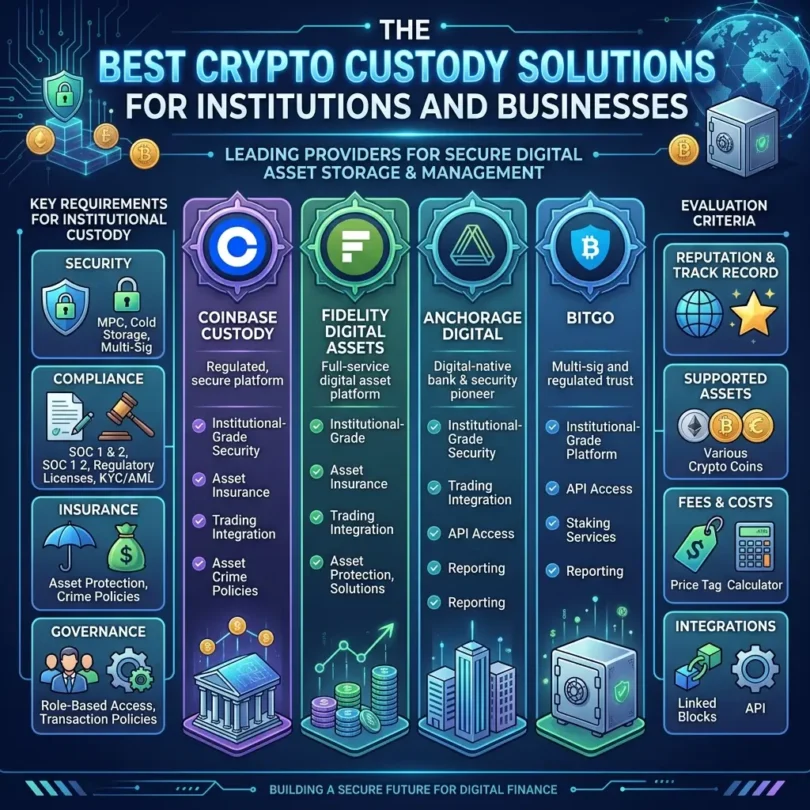

Crypto custody is one of the most important decisions for institutions, businesses, funds, family offices, exchanges, Web3 companies, payment platforms, and corporate treasury teams that hold digital assets.
A retail user may store crypto in a hardware wallet. A small trader may use a self-custody wallet. But institutions and businesses usually need more than a device and a seed phrase.
They need custody controls.
That means secure storage, access permissions, transaction approvals, policy controls, audit logs, insurance details, reporting, wallet segregation, disaster recovery, role-based access, compliance support, and clear operational procedures.
A crypto custody solution helps organizations hold and manage digital assets safely. It may use cold storage, multi-signature wallets, MPC technology, hardware security modules, qualified custody structures, institutional vaults, governance rules, withdrawal approvals, whitelists, and audit-ready reporting.
Coinbase Custody Trust Company says it is a fiduciary under New York state banking law and a Qualified Custodian, with SOC 1 Type II and SOC 2 Type II audits by Deloitte & Touche. (Coinbase) BitGo describes its qualified custody product as insured, regulated custody with keys held offline in cold storage. (The Digital Asset Infrastructure Company) Fireblocks, BitGo, Coinbase Prime, Anchorage Digital, Gemini Custody, Fidelity Digital Assets, Copper, Cobo, and other providers are commonly compared by institutions that need secure digital asset operations.
This guide compares the best crypto custody solutions for institutions and businesses, explains qualified custody, cold storage, MPC, self-custody, third-party custody, controls, risks, and the questions every organization should ask before choosing a provider.
Important Disclaimer
This article is for general informational purposes only. It is not legal, tax, accounting, investment, cybersecurity, custody, regulatory, or professional advice.
Crypto custody rules, qualified custodian requirements, insurance terms, reporting duties, licensing, state trust rules, institutional policies, and digital asset regulations can vary by country, asset type, entity type, and customer category. Always consult qualified attorneys, accountants, auditors, compliance professionals, cybersecurity experts, and licensed custody specialists before selecting a crypto custody solution.
What Is Crypto Custody?
Crypto custody means holding, protecting, and controlling access to digital assets.
In traditional systems, custody may involve a bank or trust company safeguarding customer assets. In crypto, custody focuses on protecting private keys, signing authority, wallet access, and blockchain transaction controls.
A crypto custody solution may help organizations protect:
- Bitcoin
- Ethereum
- Solana
- Stablecoins
- Tokenized assets
- NFTs
- Treasury wallets
- Customer assets
- Fund assets
- Exchange reserves
- DAO assets
- Corporate holdings
- Staked assets
- Collateral assets
- Trading balances
- Settlement assets
Crypto custody is not only storage. It is an operational control system.
A custody provider may support:
- Cold storage
- MPC wallets
- Multi-signature approvals
- Hardware security modules
- Qualified custody
- Segregated accounts
- Insurance coverage details
- Transaction policy rules
- Withdrawal whitelists
- Audit logs
- SOC reports
- Compliance documentation
- Disaster recovery
- Team permissions
- API access
- Staking from custody
- Trading from custody
- Settlement workflows
- Reporting exports
For institutions and businesses, custody is about reducing theft risk, operational mistakes, insider abuse, and regulatory exposure.
Why Crypto Custody Matters for Businesses
Crypto transactions are usually irreversible.
If a wrong person signs a transaction, if a private key is stolen, if a wallet address is wrong, or if a team member sends assets to a malicious contract, recovering funds may be impossible.
Businesses also face extra problems that individuals may not face:
- Multiple employees need access
- No single person should control all assets
- Auditors may ask for records
- Investors may ask about controls
- Tax teams need transaction reports
- Boards may need custody policy
- Regulators may ask about segregation
- Insurance carriers may ask about procedures
- Customers may ask where assets are held
- Leadership may require approval workflows
- Treasury teams may need safe settlement processes
A personal wallet may not be enough for these needs.
Common Business Crypto Custody Use Cases
Businesses may need custody for:
- Corporate Bitcoin holdings
- Stablecoin working capital
- NFT marketplace funds
- Customer deposits
- Exchange hot/cold wallet systems
- Crypto payment settlement
- Web3 treasury management
- Token grants
- DAO assets
- Fund assets
- Validator rewards
- Staking operations
- Tokenized real-world assets
- OTC settlement
- Cross-border stablecoin payments
- Institutional trading balances
- Collateral management
Each use case has different custody needs.
For example, an exchange needs hot wallet liquidity and cold storage reserves. A family office may need long-term cold storage and reporting. A payment company may need settlement wallets and policy controls. A fund may need qualified custody and audit support.
Main Types of Crypto Custody
1. Self-Custody
Self-custody means the business controls its own private keys.
This may involve:
- Hardware wallets
- Multi-signature wallets
- Safe
- Cold storage devices
- Internal key ceremonies
- Offline backups
- Internal approval policies
Pros
- Direct control
- No third-party custodian dependency
- Custom wallet setup
- Lower provider fees in some cases
- Good for crypto-native teams
Cons
- Internal security burden
- Key loss risk
- Insider risk
- Harder audits
- Complex disaster recovery
- No institutional custodian support
- No central recovery if key process fails
Self-custody may work for technically strong teams, but it can be risky without strict controls.
2. Third-Party Custody
Third-party custody means a custodian holds assets or private keys on behalf of the organization.
Examples:
- Coinbase Custody
- BitGo
- Anchorage Digital
- Gemini Custody
- Fidelity Digital Assets
- Copper
- Cobo
Pros
- Professional security infrastructure
- Institutional controls
- Audit reports
- Compliance documentation
- Insurance information
- Qualified custody options
- Operational support
- Reporting tools
- Disaster recovery systems
Cons
- Custodian risk
- Fees
- Onboarding requirements
- Withdrawal processes
- Business category restrictions
- Country restrictions
- Less direct control
- Contract complexity
Third-party custody is common for institutions that need regulated or audit-ready custody.
3. Qualified Custody
Qualified custody generally refers to custody with entities that meet certain regulatory requirements for holding client assets.
Under U.S. investment adviser custody discussions, qualified custodians can include banks, savings associations, registered broker-dealers, registered futures commission merchants, and certain foreign institutions that meet conditions. A KPMG summary of the SEC custody rule proposal explains that advisers would generally need to maintain client assets with a qualified custodian and that the custodian would need possession or control of the assets. (KPMG)
This matters especially for registered advisers, funds, and institutions that must follow specific custody rules.
Important Note
Not every crypto exchange or wallet provider is a qualified custodian. Organizations should verify legal status directly with counsel and the provider.
4. MPC Custody
MPC means Multi-Party Computation.
Instead of one private key existing in one place, MPC splits signing responsibility across multiple parties or devices. A transaction can be approved without reconstructing the full private key in one location.
MPC is popular in institutional crypto operations because it can support:
- Policy-based approvals
- No single private key exposure
- API-based workflows
- Fast settlement
- Team controls
- Institutional wallet infrastructure
Fireblocks is widely known for MPC-based digital asset infrastructure.
5. Multi-Signature Custody
Multi-signature custody requires multiple keys to approve a transaction.
Example:
- 2-of-3 approvals
- 3-of-5 approvals
- 4-of-7 approvals
Multi-signature setups are common for:
- DAO treasuries
- Company wallets
- Bitcoin cold storage
- Ethereum smart contract wallets
- Shared business wallets
Multi-sig reduces single-key risk but increases setup complexity.
6. Cold Storage
Cold storage keeps private keys offline.
This may involve:
- Hardware security modules
- Offline vaults
- Hardware wallets
- Air-gapped systems
- Secure key ceremonies
- Physical access controls
- Geographic distribution
- Offline signing workflows
Coinbase says its Vault storage combines physical security, consensus computation, and strict process controls. (Coinbase) BitGo says its custody product holds keys offline in cold storage. (The Digital Asset Infrastructure Company)
Cold storage is usually best for assets that do not need frequent movement.
7. Hot Wallet Operations
Hot wallets are connected to online systems and used for faster transfers.
Businesses may need hot wallets for:
- Exchange withdrawals
- Payment processing
- Customer withdrawals
- Fast settlement
- DeFi operations
- Trading accounts
Hot wallets are convenient but riskier. Institutions usually keep only operational balances in hot wallets and move larger reserves to cold storage.
Best Crypto Custody Solutions for Institutions and Businesses
Below are the top custody solutions to compare. The right choice depends on whether your organization needs qualified custody, MPC infrastructure, cold storage, trading integration, staking, compliance support, multi-user controls, or self-custody tools.
1. Coinbase Prime / Coinbase Custody
Best for: Institutions needing qualified custody and integrated trading
Good for: Funds, institutions, corporate treasury teams, asset managers, crypto-native businesses
Main strength: Qualified custody, institutional platform, and Coinbase ecosystem
Coinbase Prime is Coinbase’s institutional platform. It combines custody, trading, reporting, and institutional digital asset management tools.
Coinbase Prime says it is a qualified custodian supporting demanding institutional and crypto-native workflows with in-house security. (Coinbase) Coinbase Custody Trust Company says it is a fiduciary under New York state banking law and a Qualified Custodian, with SOC 1 Type II and SOC 2 Type II audits. (Coinbase)
Key Features
- Qualified custody
- Coinbase Vault storage
- Institutional trading
- Cold storage controls
- SOC reports
- New York trust company structure
- Asset support
- Staking support, where available
- Reporting tools
- API access
- Institutional onboarding
- Segregated custody options
- Governance controls
- Coinbase ecosystem access
Why Coinbase Prime Is Good
Coinbase Prime is strong for institutions that want custody and trading under one well-known platform. It may be especially useful for organizations already comfortable with Coinbase’s ecosystem.
It also has strong brand recognition and institutional positioning.
Best Fit
Coinbase Prime may fit:
- Institutions
- Asset managers
- Funds
- Corporate treasury teams
- Crypto-native companies
- Large businesses holding crypto
- Teams needing qualified custody
- Organizations needing custody plus trading
Possible Downsides
Coinbase Prime may not be the cheapest or most flexible option for every business. Organizations should review contract terms, supported assets, staking rules, custody controls, withdrawal processes, service-level expectations, and jurisdiction fit.
2. BitGo
Best for: Institutional custody, cold storage, and digital asset infrastructure
Good for: Businesses, platforms, funds, exchanges, treasury teams
Main strength: Qualified custody and long-standing institutional custody infrastructure
BitGo is one of the best-known crypto custody and digital asset infrastructure companies.
BitGo says its qualified custody product provides insured, regulated, qualified custody with keys held offline in cold storage. (The Digital Asset Infrastructure Company) BitGo’s broader site says its platform brings custody, prime services, settlement, trading, and other digital asset infrastructure into one operational flow. (The Digital Asset Infrastructure Company)
Reuters reported in January 2026 that BitGo raised $212.8 million in a U.S. IPO and was valued at $2.08 billion at IPO pricing. (Reuters) Reuters also reported BitGo debuted on the NYSE with a $2.59 billion valuation after shares rose on debut. (Reuters)
Key Features
- Qualified custody
- Cold storage
- Institutional wallets
- Insurance information
- Multi-signature technology history
- TSS/MPC-style wallet infrastructure
- Trading and settlement tools
- Prime services
- Platform custody
- Policy controls
- Reporting tools
- API access
- Institutional onboarding
Why BitGo Is Good
BitGo is strong for organizations that want an established custody provider with institutional infrastructure. Its custody offering is built around regulated, insured, offline key storage.
It may fit funds, exchanges, crypto companies, and businesses needing secure custody plus operational workflows.
Best Fit
BitGo may fit:
- Institutions
- Funds
- Exchanges
- Crypto companies
- Treasury teams
- Businesses needing qualified custody
- Companies needing settlement tools
- Platforms handling customer assets
Possible Downsides
BitGo’s institutional services may be more than small businesses need. Organizations should review fees, asset support, withdrawal procedures, insurance terms, contract details, and onboarding requirements.
3. Anchorage Digital
Best for: Regulated digital asset custody and bank-style institutional custody
Good for: Institutions, asset managers, funds, government-style entities, serious businesses
Main strength: Regulated digital asset custody infrastructure
Anchorage Digital is a major institutional crypto custody provider. It is commonly compared with Coinbase Custody, BitGo, Gemini Custody, and Fidelity Digital Assets.
Anchorage is known for regulated custody and institutional digital asset services.
Key Features
- Institutional custody
- Regulated custody structure
- Digital asset bank positioning
- Governance controls
- Cold storage and secure signing systems
- Staking support, where available
- Trading and settlement integrations
- Asset support
- Reporting tools
- Compliance support
- Institutional onboarding
Why Anchorage Digital Is Good
Anchorage is a strong option for organizations that prioritize regulated custody and institutional-grade controls.
It may be especially attractive for entities that need a serious custody partner rather than a basic exchange wallet.
Best Fit
Anchorage Digital may fit:
- Institutions
- Funds
- Asset managers
- Businesses needing regulated custody
- Government-style entities
- Crypto-native companies
- Large digital asset holders
Possible Downsides
Anchorage may be more enterprise-focused than small businesses need. Organizations should confirm minimums, pricing, supported assets, jurisdiction, and custody structure directly.
4. Fireblocks
Best for: MPC wallet infrastructure and digital asset operations
Good for: Exchanges, payment companies, Web3 businesses, fintech platforms, trading desks
Main strength: MPC-based operational wallet infrastructure
Fireblocks is one of the leading digital asset infrastructure platforms. It is often used by organizations that need secure transaction workflows, MPC wallets, settlement, and policy-based controls.
Fireblocks is especially strong for companies that move assets often rather than simply store them in cold vaults.
Key Features
- MPC wallet infrastructure
- Policy engine
- Team approval workflows
- Wallet governance
- API access
- DeFi and Web3 connectivity
- Settlement tools
- Tokenization support
- Payment workflows
- Exchange connectivity
- Secure transaction signing
- Role-based access
- Operational controls
- Multi-chain support
Why Fireblocks Is Good
Fireblocks is strong for businesses that need to move assets securely and frequently. For example, a payment company, exchange, OTC desk, or Web3 app may need controlled transaction signing every day.
A cold vault alone may be too slow for this type of operation. Fireblocks gives teams wallet infrastructure with policy controls and automation.
Best Fit
Fireblocks may fit:
- Payment companies
- Exchanges
- Fintech platforms
- Web3 startups
- Trading desks
- Tokenization platforms
- Businesses needing MPC wallets
- Teams needing secure transaction operations
- Companies moving digital assets frequently
Possible Downsides
Fireblocks is not the same as simply hiring a qualified custodian. Some businesses may need both Fireblocks-style infrastructure and a qualified custodian, depending on legal requirements. Review custody model carefully with counsel.
5. Gemini Custody
Best for: U.S.-focused regulated custody and exchange ecosystem
Good for: Institutions, funds, businesses, security-focused organizations
Main strength: Custody from a regulated crypto platform
Gemini Custody is an institutional custody solution from Gemini. It is commonly compared with Coinbase Custody, BitGo, Anchorage, and Fidelity Digital Assets.
Gemini is known for a compliance-focused brand and U.S.-based crypto services.
Key Features
- Institutional custody
- Cold storage
- Security controls
- Exchange ecosystem
- Asset support
- Reporting tools
- Account controls
- Compliance-focused onboarding
- Potential insurance information, depending on terms
- Institutional support
Why Gemini Custody Is Good
Gemini Custody may fit organizations that want a U.S.-based custody provider with exchange ecosystem support and a security-focused brand.
Best Fit
Gemini Custody may fit:
- U.S.-based institutions
- Funds
- Businesses
- Security-focused teams
- Organizations already using Gemini
- Companies wanting regulated custody options
Possible Downsides
Businesses should verify supported assets, fees, custody legal structure, insurance terms, reporting quality, and onboarding requirements.
6. Fidelity Digital Assets
Best for: Institutions that prefer a large traditional brand entering digital assets
Good for: Institutions, family offices, asset managers, long-term holders
Main strength: Institutional brand, custody focus, and traditional market experience
Fidelity Digital Assets is commonly compared by institutions that want digital asset custody from a large established brand.
It is especially relevant for institutions that want long-term Bitcoin custody, operational controls, and reporting from a brand known outside crypto-native circles.
Key Features
- Institutional custody
- Long-term digital asset storage
- Security controls
- Reporting tools
- Institutional onboarding
- Research and client support
- Asset manager focus
- Traditional brand recognition
- Operational custody procedures
Why Fidelity Digital Assets Is Good
Fidelity Digital Assets may appeal to institutions that want a custody partner with a long operating background in asset services and institutional client support.
Best Fit
Fidelity Digital Assets may fit:
- Institutions
- Family offices
- Asset managers
- Long-term Bitcoin holders
- Businesses wanting a traditional brand
- Conservative digital asset allocators
Possible Downsides
Asset support and product availability may be narrower than some crypto-native providers. Businesses should verify supported assets and services directly.
7. Copper
Best for: Institutional custody and off-exchange settlement workflows
Good for: Trading firms, funds, institutions, liquidity-focused businesses
Main strength: Custody plus institutional settlement network
Copper is known for institutional digital asset custody and settlement tools. It is commonly used by trading-focused firms and institutions that need secure asset movement across venues.
Key Features
- Institutional custody
- Settlement network
- Off-exchange settlement workflows
- Policy controls
- Multi-user approvals
- Trading venue connectivity
- Reporting tools
- Asset support
- Security infrastructure
- Institutional onboarding
Why Copper Is Good
Copper can be useful for institutions that trade across multiple venues but want stronger control over custody and settlement risk.
For active institutions, custody is not only about storing assets. It is also about moving assets safely between trading, settlement, and reporting workflows.
Best Fit
Copper may fit:
- Trading firms
- Funds
- Institutions
- Liquidity-focused businesses
- Active digital asset managers
- Organizations needing settlement workflows
Possible Downsides
Copper may be less relevant for small businesses that simply need long-term cold storage. Review jurisdiction, supported assets, fees, and settlement partners carefully.
8. Cobo
Best for: Custody infrastructure and wallet technology for businesses
Good for: Exchanges, Web3 companies, institutions, payment platforms
Main strength: Custody infrastructure and wallet services
Cobo is a digital asset custody and wallet infrastructure provider. It is commonly compared in institutional custody discussions and supports business wallet operations.
Key Features
- Custody solutions
- Wallet infrastructure
- MPC wallet options
- Multi-user controls
- DeFi access controls
- Exchange-style wallet support
- Staking support, depending on assets
- API tools
- Business wallet management
- Reporting tools
- Institutional custody workflows
Why Cobo Is Good
Cobo may be useful for businesses that need custody infrastructure rather than only a simple vault. Exchanges, Web3 apps, and payment platforms may need wallet systems that support many users and transaction flows.
Best Fit
Cobo may fit:
- Exchanges
- Web3 companies
- Payment platforms
- Crypto-native businesses
- Institutions
- Teams needing wallet infrastructure
- Businesses needing MPC or custody tech
Possible Downsides
Businesses should compare Cobo’s custody model, jurisdiction, asset support, compliance documentation, and integration requirements.
9. Fireblocks + Qualified Custodian Hybrid Setup
Best for: Businesses needing both operations and qualified custody
Good for: Complex institutions, funds, platforms, payment firms
Main strength: Separation of storage and operational wallet controls
Some institutions may use more than one solution.
For example:
- Qualified custodian for long-term reserves
- Fireblocks for operational wallets
- Hardware wallets for emergency recovery
- Internal policies for approvals
- External auditor review
- Crypto accounting software for records
This hybrid setup can be useful when a business needs both secure storage and fast digital asset movement.
Why Hybrid Custody Is Good
One tool may not solve everything.
A qualified custodian may be best for long-term assets, while an MPC infrastructure platform may be better for daily operations. A business can separate reserves from operational balances.
Best Fit
Hybrid custody may fit:
- Payment businesses
- Exchanges
- Large Web3 companies
- Funds
- Treasury teams
- Platforms with customer flows
- Businesses moving assets often
Possible Downsides
Hybrid custody adds complexity. Policies, reconciliation, reporting, and access control must be carefully designed.
10. Self-Custody Multi-Sig With Safe or Bitcoin Multi-Sig
Best for: Crypto-native teams wanting direct control
Good for: DAOs, Web3 startups, small treasury teams, technically skilled businesses
Main strength: Direct control with multi-person approvals
Some businesses use self-custody multi-signature wallets instead of a third-party custodian.
For Ethereum and EVM chains, Safe is commonly used. For Bitcoin, teams may use multi-sig setups with hardware wallets such as Coldcard, Ledger, Trezor, and wallet software like Sparrow or Electrum.
Key Features
- Multi-person approvals
- Direct wallet control
- No single private key holder
- Transparent on-chain transactions
- Custom policies
- Hardware wallet support
- DAO treasury support
- Lower third-party dependency
- Team-controlled recovery process
Why Self-Custody Multi-Sig Is Good
Self-custody multi-sig is useful for crypto-native teams that understand wallet security and want direct control.
It can reduce the risk that one person can steal or lose all assets.
Best Fit
Self-custody multi-sig may fit:
- DAOs
- Web3 teams
- Small crypto-native businesses
- Technical founders
- Teams wanting direct control
- Treasury wallets
- Grant programs
- NFT project treasuries
Possible Downsides
Self-custody multi-sig requires serious operational discipline. If signers lose keys, collude, become unavailable, or fail to document recovery procedures, assets can be stuck or lost. Businesses should use professional setup help for large amounts.
Quick Comparison Table
| Custody Solution | Best For | Main Strength | Good Fit |
|---|---|---|---|
| Coinbase Prime | Qualified custody + trading | Regulated custody and platform tools | Institutions and funds |
| BitGo | Institutional custody | Cold storage and qualified custody | Funds, exchanges, businesses |
| Anchorage Digital | Regulated institutional custody | Digital asset custody infrastructure | Large institutions |
| Fireblocks | MPC operations | Secure transaction workflows | Payment firms and exchanges |
| Gemini Custody | U.S. custody | Regulated platform custody | U.S. institutions |
| Fidelity Digital Assets | Traditional brand custody | Institutional long-term storage | Asset managers |
| Copper | Custody + settlement | Off-exchange settlement workflows | Trading firms |
| Cobo | Wallet infrastructure | Custody and MPC tools | Crypto-native businesses |
| Hybrid custody | Complex operations | Custody plus operations | Large Web3 companies |
| Self-custody multi-sig | Direct control | Multi-person approvals | DAOs and technical teams |
What to Look for in a Crypto Custody Solution
1. Custody Model
Ask:
- Is it third-party custody?
- Is it qualified custody?
- Is it MPC wallet infrastructure?
- Is it self-custody software?
- Is it cold storage?
- Is it hot wallet infrastructure?
- Is it hybrid custody?
Do not assume all custody solutions work the same way.
2. Regulatory Status
Ask:
- Is the custodian regulated?
- Is it a trust company?
- Is it a qualified custodian for your use case?
- Which jurisdiction applies?
- What licenses or registrations does it hold?
- Does counsel agree it fits your obligations?
Coinbase Custody Trust Company states it is a fiduciary under New York state banking law and a Qualified Custodian. (Coinbase)
3. Cold Storage Design
Ask:
- Are assets held offline?
- Are keys geographically distributed?
- How are withdrawals approved?
- How are key ceremonies handled?
- Who can access signing systems?
- Are there physical vault controls?
- Is there disaster recovery?
4. MPC or Multi-Sig Controls
Ask:
- Is signing based on MPC?
- Is signing based on multi-sig?
- How many approvals are required?
- Can policies be customized?
- Can roles be separated?
- Are approvals logged?
- Can emergency approvals be disabled?
5. Insurance Details
Insurance can be useful, but terms matter.
Ask:
- What exactly is covered?
- What is excluded?
- Is theft covered?
- Is employee error covered?
- Is social engineering covered?
- Is smart contract loss covered?
- Is policy limit shared across clients?
- Who is the insurer?
- Can you review certificate or policy summary?
Do not rely on the word “insured” without reading details.
6. SOC Reports and Audits
Ask:
- Does the provider have SOC 1?
- Does it have SOC 2?
- Are reports Type I or Type II?
- Who performed the audit?
- Can customers review reports under NDA?
Coinbase Custody says it maintains SOC 1 Type II and SOC 2 Type II audits by Deloitte & Touche. (Coinbase)
7. Asset Support
Check support for:
- Bitcoin
- Ethereum
- Solana
- XRP
- stablecoins
- tokenized assets
- NFTs
- staking assets
- Layer-2 assets
- DeFi tokens
- governance tokens
Do not choose a custodian before confirming your exact assets.
8. Staking Support
Some custodians support staking from custody.
Ask:
- Which assets can be staked?
- Are assets moved?
- Who is validator?
- What are slashing risks?
- How are rewards reported?
- Can staked assets be withdrawn?
- What fees apply?
9. Reporting and Accounting Exports
A good custodian should support:
- Transaction reports
- Balance reports
- Audit reports
- Tax support files
- Wallet address records
- Settlement records
- API exports
- CSV exports
- Accountant access
- Integration with crypto accounting software
10. Customer Support and Incident Response
Ask:
- Is support 24/7?
- Is there dedicated account management?
- What happens during an incident?
- How fast can withdrawals be reviewed?
- Who approves emergency actions?
- What is escalation path?
Crypto Custody Risk Checklist
Crypto custody risks include:
- Private key theft
- Insider abuse
- Employee mistake
- Phishing attack
- Vendor compromise
- Smart contract exploit
- Wrong address transfer
- Custodian insolvency
- Regulatory change
- Withdrawal delay
- Account freeze
- Poor recovery process
- Inadequate insurance
- Weak internal approvals
- Poor audit trail
- Chain-specific risk
- Staking slashing risk
- Legal ownership ambiguity
- Unclear segregation
A custody provider should help reduce risk, not create new confusion.
Questions to Ask Before Choosing a Custodian
Ask every provider:
- Are you a qualified custodian for our use case?
- Which legal entity holds the assets?
- Are assets segregated by customer?
- Are assets held in cold storage?
- What percentage is kept offline?
- What insurance applies?
- What is excluded from insurance?
- What SOC reports are available?
- Which assets are supported?
- Which jurisdictions are supported?
- Do you support staking?
- Do you support governance voting?
- How are withdrawals approved?
- Can we set custom policies?
- Can we use role-based access?
- Can we require multiple approvals?
- Can we whitelist addresses?
- Can we set transaction limits?
- What happens if our admin leaves?
- What disaster recovery process exists?
- What reports can we export?
- Can our auditor access reports?
- What APIs are available?
- What fees apply?
- What happens if the provider is acquired, insolvent, or exits a region?
Best Custody Setup by Organization Type
Best for Funds and Asset Managers
Compare:
- Coinbase Prime
- BitGo
- Anchorage Digital
- Gemini Custody
- Fidelity Digital Assets
Focus on:
- Qualified custody
- Audit reports
- regulatory status
- asset segregation
- insurance terms
- reporting
- counsel review
Best for Web3 Businesses
Compare:
- Fireblocks
- BitGo
- Coinbase Prime
- Cobo
- Self-custody multi-sig
Focus on:
- Wallet operations
- transaction approvals
- DeFi controls
- stablecoin settlement
- API workflows
- treasury reporting
Best for Exchanges and Platforms
Compare:
- Fireblocks
- BitGo
- Cobo
- Coinbase Prime
- Copper
Focus on:
- Hot/cold wallet separation
- withdrawal controls
- customer asset segregation
- settlement
- API uptime
- incident response
Best for Family Offices
Compare:
- Coinbase Prime
- BitGo
- Fidelity Digital Assets
- Anchorage Digital
- Gemini Custody
Focus on:
- long-term cold storage
- reporting
- estate planning support
- asset support
- security procedures
Best for DAOs
Compare:
- Safe
- Fireblocks
- Cobo
- hybrid custody
- hardware wallet multi-sig
Focus on:
- multi-signature approvals
- transparency
- treasury controls
- signer management
- governance process
Best for Payment Companies
Compare:
- Fireblocks
- BitGo
- Copper
- Cobo
- qualified custodian hybrid setup
Focus on:
- fast movement
- operational wallets
- policy controls
- stablecoin support
- reporting
- risk limits
Common Crypto Custody Mistakes
Mistake 1: Using an Exchange Account as Institutional Custody
An exchange account may not meet institutional custody needs. Custody requires controls, segregation, audit support, and legal review.
Mistake 2: Not Verifying Qualified Custodian Status
Do not rely on marketing language. Verify legal status with counsel.
Mistake 3: Ignoring Insurance Exclusions
Insurance may not cover phishing, employee mistakes, smart contract losses, or certain theft events.
Mistake 4: Giving One Person Too Much Control
No single employee should be able to move all assets alone.
Mistake 5: Not Testing Withdrawal Procedures
Test small withdrawals and emergency procedures before holding large amounts.
Mistake 6: Mixing Customer and Company Assets
Keep customer assets separate from company treasury where required.
Mistake 7: Not Keeping Audit Logs
Every approval, withdrawal, transfer, and policy change should be recorded.
Mistake 8: Ignoring Staking Risks
Staking can involve slashing, lockups, validator risk, and reporting complexity.
Mistake 9: No Succession Plan
If key personnel leave, become unavailable, or pass away, access procedures must still work.
Mistake 10: Choosing Only Based on Fees
Low fees are not worth weak security, poor reporting, unclear legal status, or bad support.
Internal Custody Policy Checklist
Every business holding meaningful crypto should create a written custody policy.
Include:
- Custody provider name
- Legal entity account owner
- Supported wallets
- Asset list
- Approval roles
- Withdrawal limits
- Address whitelisting rules
- Emergency contacts
- Incident response process
- Key person backup plan
- Reporting schedule
- Monthly reconciliation process
- Insurance documentation
- Audit report storage
- Tax report process
- Accounting software process
- Employee access review
- Vendor review schedule
- Board or management approval rules
- Disaster recovery plan
A custody policy helps prevent confusion during stressful events.
Crypto Custody and Accounting
Custody and accounting should work together.
A business should know:
- What assets are held
- Where assets are held
- Who controls them
- What they cost
- What they are worth
- What moved during the month
- Why assets moved
- Who approved movement
- How records are exported
- How reports match books
Crypto accounting software such as Bitwave, Cryptio, TaxBit, Ledgible, Koinly, CoinTracker, or CoinLedger may be used alongside custody tools.
Custody protects access. Accounting explains activity.
Both are needed.
Final Verdict: What Are the Best Crypto Custody Solutions?
The best crypto custody solution depends on the organization.
For most institutions and businesses:
- Best qualified custody plus trading: Coinbase Prime
- Best institutional custody infrastructure: BitGo
- Best regulated institutional custody: Anchorage Digital
- Best MPC operational wallet infrastructure: Fireblocks
- Best U.S.-focused custody alternative: Gemini Custody
- Best traditional-brand institutional option: Fidelity Digital Assets
- Best custody plus settlement workflow: Copper
- Best wallet infrastructure provider: Cobo
- Best complex setup: Hybrid custody using qualified custodian plus MPC operations
- Best self-controlled team setup: Multi-signature custody with Safe or Bitcoin multi-sig
A fund or asset manager may prioritize qualified custody. A Web3 company may need MPC wallet operations. A payment company may need fast settlement controls. A family office may want long-term cold storage. A DAO may prefer multi-signature self-custody. A large platform may need a hybrid model.
The most important rule is simple: custody should match the risk.
If the organization holds a meaningful amount of digital assets, a simple exchange login is not enough. The business needs proper approvals, reporting, insurance review, audit support, disaster recovery, and a written custody policy.
FAQs About Crypto Custody Solutions
What is crypto custody?
Crypto custody is the process of safeguarding digital assets and controlling access to private keys, wallet signing, withdrawals, and transaction approvals.
What are the best crypto custody solutions?
Common solutions to compare include Coinbase Prime, BitGo, Anchorage Digital, Fireblocks, Gemini Custody, Fidelity Digital Assets, Copper, Cobo, hybrid custody setups, and self-custody multi-signature wallets.
What is a qualified crypto custodian?
A qualified custodian is an entity that meets certain legal requirements for holding client assets. For U.S. adviser custody discussions, qualified custodians can include certain banks, broker-dealers, futures commission merchants, and foreign institutions that meet conditions. (KPMG)
Is Coinbase Custody a qualified custodian?
Coinbase Custody Trust Company says it is a fiduciary under New York state banking law and a Qualified Custodian. (Coinbase)
Is BitGo a qualified custodian?
BitGo describes its qualified custody product as insured, regulated, qualified custody with keys held offline in cold storage. (The Digital Asset Infrastructure Company)
What is MPC custody?
MPC custody uses Multi-Party Computation to split signing responsibility so a full private key does not need to exist in one place during transaction approval.
What is cold storage?
Cold storage keeps private keys offline. It is commonly used for long-term holdings and reserves that do not need frequent movement.
Is self-custody good for businesses?
Self-custody can work for technically strong teams, especially with multi-signature controls. But it requires strict processes, backups, signer management, and professional review for large amounts.
Is crypto custody insured?
Some custodians provide insurance information, but coverage varies. Always review what is covered, what is excluded, policy limits, and whether the coverage applies to your specific situation.
What is the safest crypto custody solution?
There is no single safest option for every organization. The safest setup depends on asset value, transaction frequency, legal duties, team size, internal controls, custody model, and reporting needs.
Should a business use Fireblocks or a custodian?
Fireblocks is often used for secure wallet operations and MPC workflows. Some businesses also need a qualified custodian for long-term storage or regulatory reasons. A hybrid setup may be best for complex organizations.
What should institutions ask before choosing a custodian?
Institutions should ask about qualified custodian status, legal entity, segregation, cold storage, insurance, SOC reports, asset support, withdrawal approvals, role-based access, reporting, APIs, fees, and disaster recovery.
Suggested Internal Links
Add these internal links when related articles are published:
- Best Crypto Tax Software for Investors and Traders
- Best Crypto Exchanges for Beginners and Active Traders
- Best Crypto Wallets for Safe Bitcoin and Altcoin Storage
- Best Hardware Wallets for Long-Term Crypto Security
- Best Crypto Portfolio Trackers for Serious Investors
- Best Crypto Accounting Software for Businesses
- Best Crypto Payment Gateways for Online Businesses
- Best Crypto Security Tools to Protect Digital Assets
- Best Crypto Tax Accountants and Reporting Services
SEO Keywords to Use Naturally
Primary Keyword: crypto custody solutions
Secondary Keywords: crypto custody, digital asset custody, institutional crypto custody, best crypto custodian, qualified crypto custodian, crypto cold storage, crypto MPC custody, crypto multi-signature custody, Coinbase Prime custody, Coinbase Custody, BitGo custody, Anchorage Digital custody, Fireblocks custody, Gemini Custody, Fidelity Digital Assets custody, Copper crypto custody, Cobo custody, crypto custody for businesses, crypto custody for institutions, digital asset custodian, cold storage custody, crypto vault storage, crypto custody insurance, crypto custody controls, crypto custody policy, crypto treasury custody.